http://www.readwritethink.org/classroom-resources/student-interactives/stapleless-book-30010.html
Contribute to ReadWriteThink / RSS / FAQs / Site Demonstrations / Contact Us
![]()
![]()
Download the plug-in tools you need to use our games and tools, or check to see if you've got the latest version.
![]()
Looking for ways to engage your students in online literacy learning? Find more interactive tools that help them accomplish a variety of goals-from organizing their thoughts to learning about language.
![]()
Check out our collection of strategy guides to find effective literacy teaching and learning strategies to use in your classroom.
![]()
Home › Classroom Resources › Student Interactives
Student Interactive
Stapleless Book
![]()
| Grades | K – 12 |
| Interactive Type | Writing & Publishing Prose |
| Tech Requirement | |
| URL | http://www.readwritethink.org /files/resources/interactives /stapleless/ |
| ABOUT THIS INTERACTIVE |
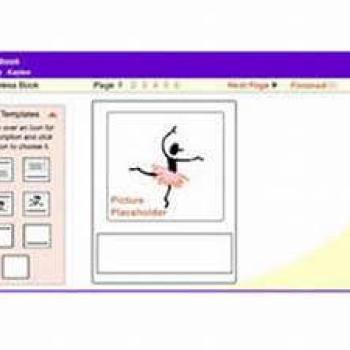
The Stapleless Book is designed to allow users to create with ease an eight-page book simply by folding and cutting. No tape or staples are required. Students and teachers alike can use the Stapleless Book for taking notes while reading, making picture books, collecting facts, or creating vocabulary booklets. Students can choose from seven different layouts for the pages of their books.
The tool is easy to use, made even easier with the Stapleless Book Planning Sheet, a printable PDF that book creators can use to draft and revise their work before creating and printing their final books. View the video demonstration for the Stapleless Book to see how to fold and cut the printout.
For additional ideas on how to use this tool, see Stapleless Book in the Parent & Afterschool Resources section.
Grades 3 – 5 | Lesson Plan | Standard Lesson
Learning to Learn with Miss Alaineus: A Vocabulary Disaster
Modeled on the activities in Miss Alaineus: A Vocabulary Disaster, a picture book, students combine vocabulary exploration with word play by planning their own vocabulary parade.
Grades 3 – 5 | Lesson Plan | Standard Lesson
Alaska Native Stories: Using Narrative to Introduce Expository Text
Tradition and technology come together in this lesson in which students learn about Alaskan animals through Native American tales and their own online research.
Grades 3 – 5 | Lesson Plan | Standard Lesson
Book Report Alternative: The Elements of Fiction
Students identify the elements of fiction in a book they have read and share summaries of them by writing and illustrating their own mini-book.
Grades 6 – 8 | Lesson Plan | Minilesson
Using the Check and Line Method to Enhance Reading Comprehension
Do your students skim assigned text material without even engaging their brains? The Check and Line method encourages students to think about what they are reading and monitor their own comprehension of the information.
Grades 6 – 8 | Lesson Plan | Standard Lesson
Teaching Voice with Anthony Browne’s Voices in the Park
Students analyze Voices in the Park by Anthony Browne to determine how an author keeps an audience interested by creating voice and to applying that knowledge to their own writing.
Grades 6 – 8 | Lesson Plan | Standard Lesson
What Am I? Teaching Poetry through Riddles
Students explore figurative language in poetry by reading and writing riddle poems.
Grades 4 – 6 | Lesson Plan | Recurring Lesson
Guided Comprehension: Monitoring Using the INSERT Technique
Based on the Guided Comprehension Model developed by Maureen McLaughlin and Mary Beth Allen, this lesson introduces students to the comprehension strategy of monitoring.
Grades K – 5 | Lesson Plan | Standard Lesson
Spelling Cheerleading: Integrating Movement and Spelling Generalizations
"2-4-6-8, students will be spelling great" in this lesson that teaches the y rule for adding suffixes through cheering the spelling of words aloud, word sorts, and writing stories.
Grades 3 – 5 | Lesson Plan | Standard Lesson
Blending Fiction and Nonfiction to Improve Comprehension and Writing Skills
Students use a text set to increase understanding of content area material and demonstrate what they have learned by writing an original piece that blends together narrative and expository elements.
Grades 3 – 5 | Lesson Plan | Standard Lesson
Teaching Point of View With Two Bad Ants
Students will be crawling all over this assignment when they use illustrations and text to learn about life from a bug’s point of view.
Grades 3 – 5 | Lesson Plan | Standard Lesson
What If We Changed the Book? Problem-Posing with Sixteen Cows
After reading a piece of math-related children’s literature aloud, students pose and solve new problems by asking what-if questions about the events in the story.
Grades 3 – 5 | Lesson Plan | Standard Lesson
Bridging Literature and Mathematics by Visualizing Mathematical Concepts
During interactive read-aloud sessions, students identify how an author conveys mathematical information about animals’ sizes and abilities. They then conduct research projects focusing on the same mathematical concepts.
Grades 3 – 5 | Lesson Plan | Unit
Literature as a Jumping Off Point for Nonfiction Inquiry
Students use text sets to research a topic inspired by a fiction book they have read. A text set is a collection of multiple text genres with a single focus.
Grades 3 – 5 | Lesson Plan | Standard Lesson
Once Upon a Time Rethought: Writing Fractured Fairy Tales
Students read and analyze fairy tales, identifying their common elements. They then write their own “fractured” fairy tales by changing one of the literary elements found in the original.
Grades 6 – 8 | Lesson Plan | Standard Lesson
You Know the Movie is ComingNow What?
In this lesson, students read a literary text with the eye of a director, selecting scenes from the text and putting a cinematic spin on them.
Grades 3 – 5 | Lesson Plan | Standard Lesson
Our Classroom: Writing an Owner’s Manual
Students write an owner’s manual that helps them get to know their classroom, provides them with a sense of ownership, and lets others know about their classroom.
Grades 6 – 8 | Lesson Plan | Standard Lesson
Book Report Alternative: Creating a Childhood for a Character
Students explore familiar literary characters, usually first encountered as adults, but whose childhood stories are only told later. Students then create childhoods for adult characters from books of their choice.
Grades 6 – 8 | Lesson Plan | Unit
Let It Grow: An Inquiry-Based Organic Gardening Research Project
Students learn about organic gardening by developing their own research questions, conducting research, gardening at their school, creating signs about their plants, and presenting their research to the class.
Grades K – 12 | Student Interactive | Writing & Publishing Prose
The interactive Printing Press is designed to assist students in creating newspapers, brochures, and flyers.
Grades K – 8 | Student Interactive | Writing & Publishing Prose
The Book Cover Creator is designed to allow users to type and illustrate front book covers, front and back covers, and full dust jackets. Students can use the tool to create new covers for books that they read as well as to create covers for books they write individually or as a class.
Grades 3 – 12 | Student Interactive | Writing & Publishing Prose
The Flip Book is designed to allow users to type and illustrate tabbed flip books up to ten pages long. Students and teachers can use the flip book for taking notes while reading, making picture books, collecting facts, or creating question and answer booklets.
Grades 3 – 12 | Calendar Activity |  October 3
Gwendolyn Brooks published Bronzeville Boys and Girls in 1956.
After students have read and discussed several poems from Brooks' collection, they create a poetry anthology for their own family, neighborhood, or classroom.
Grades 3 – 6 | Calendar Activity |  April 18
Participate in Poem in Your Pocket Day!
Students select a poem and create a Stapleless Book using the interactive tool.
Grades K – 5 | Strategy Guide
Implementing the Writing Process
This strategy guide explains the writing process and offers practical methods for applying it in your classroom to help students become proficient writers.
![]()

