http://www.readwritethink.org/classroom-resources/student-interactives/story-30008.html
Contribute to ReadWriteThink / RSS / FAQs / Site Demonstrations / Contact Us
![]()
![]()
Download the plug-in tools you need to use our games and tools, or check to see if you've got the latest version.
![]()
Looking for ways to engage your students in online literacy learning? Find more interactive tools that help them accomplish a variety of goals-from organizing their thoughts to learning about language.
![]()
Check out our collection of strategy guides to find effective literacy teaching and learning strategies to use in your classroom.
![]()
Home › Classroom Resources › Student Interactives
Student Interactive
Story Map
![]()
| Grades | K – 12 |
| Interactive Type | Organizing & Summarizing |
| Tech Requirement | |
| URL | http://www.readwritethink.org /files/resources/interactives /storymap/ |
| ABOUT THIS INTERACTIVE |
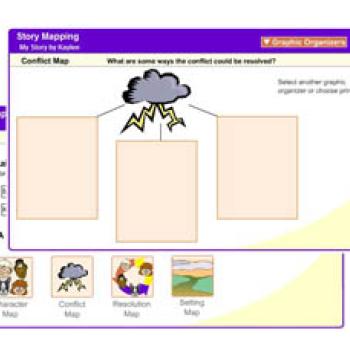
The Story Map interactive includes a set of graphic organizers designed to assist teachers and students in prewriting and postreading activities. The organizers are intended to focus on the key elements of character, setting, conflict, and resolution development. Students can develop multiple characters, for example, in preparation for writing their own fiction, or they may reflect on and further develop characters from stories they have read. After completing individual sections or the entire organizer, students have the ability to print out their final versions for feedback and assessment. The versatility of this tool allows it to be used in multiple contexts.
Grades 3 – 5 | Lesson Plan | Unit
Picture books provide the basis for an analysis of fairy tale elements before students write their own original tales.
Grades 3 – 5 | Lesson Plan
Get the Reel Scoop: Comparing Books to Movies
Students compare a book to its film adaptation, and then perform readers theater of a scene from the book that they feel was not well represented in the movie version.
Grades 3 – 5 | Lesson Plan | Minilesson
Bright Morning: Exploring Character Development in Fiction
Students work as a class to explore a character in a book they have read by identifying traits and finding textual references to support their choices.
Grades 3 – 5 | Lesson Plan | Standard Lesson
Using Picture Books to Teach Characterization in Writing Workshop
Students explore character development through experiences with picture books. They learn about the connections between reading and writing and apply the information they learn to revisions of their own writing.
Grades 3 – 5 | Lesson Plan | Standard Lesson
Literature as a Catalyst for Social Action: Breaking Barriers, Building Bridges
Students are invited to confront and discuss issues of injustice and intolerance in response to reading a variety of fiction and nonfiction texts.
Grades 3 – 5 | Lesson Plan | Standard Lesson
Using Picture Books to Teach Setting Development in Writing Workshop
Students use a graphic organizer to analyze setting development in picture books. They then apply what they have learned to their own writing.
Grades 3 – 5 | Lesson Plan | Standard Lesson
Using Writing and Role-Play to Engage the Reluctant Writer
What does the world look like through a javelina’s eyes? Students become javelinas in this lesson when they analyze a character and write from his or her perspective.
Grades 3 – 5 | Lesson Plan | Unit
Behind the Scenes With Cinderella
Cinderella without castles, coaches, or ball gowns? Students use versions of Cinderella to explore how the setting of a storytime, place, and cultureaffects the characters and plot.
Grades 3 – 5 | Lesson Plan | Standard Lesson
Thundering Tall Tales: Using Read-Aloud as a Springboard to Writing
Imagination and application are key to this tall tale lesson in which students take what they know about tall tales to spin a yarn of their own.
Grades 3 – 5 | Lesson Plan | Unit
Examining Plot Conflict through a Comparison/Contrast Essay
Students explore picture books to identify the characteristics of four types of conflict. They then write about a conflict they have experienced and compare it to a conflict from literature.
Grades 3 – 5 | Lesson Plan | Standard Lesson
Using Picture Books to Teach Plot Development and Conflict Resolution
Students read picture books to explore the concepts of plot development and conflict resolution. They first learn about the connections between reading and writing, and then revise their own writing.
Grades 3 – 5 | Lesson Plan | Unit
Literature as a Jumping Off Point for Nonfiction Inquiry
Students use text sets to research a topic inspired by a fiction book they have read. A text set is a collection of multiple text genres with a single focus.
Grades 3 – 5 | Lesson Plan | Standard Lesson
Once Upon a Time Rethought: Writing Fractured Fairy Tales
Students read and analyze fairy tales, identifying their common elements. They then write their own “fractured” fairy tales by changing one of the literary elements found in the original.
Grades 3 – 5 | Lesson Plan | Standard Lesson
Inferring How and Why Characters Change
Students will really get into character when they read short stories and analyze the how’s and why’s of characters’ behaviors.
Grades 3 – 5 | Lesson Plan | Standard Lesson
Alter Egos and More with Avi’s "Who Was That Masked Man, Anyway?"
After reading Avi’s novel "Who Was That Masked Man, Anyway?", students create an alter ego for themselves and use it to write their own radio show, modeled after the book.
Grades 3 – 5 | Lesson Plan | Unit
Zines for Kids: Multigenre Texts About Media Icons
Special edition! Students use ReadWriteThink tools to create magazines about prominent figures using a variety of writing genres and styles.
Grades 3 – 5 | Lesson Plan | Standard Lesson
What’s in a narrative? Students find out in this lesson in which they explore four narrative elements—setting, characters, problem/solution, and plot, through purpose-driven read-alouds and independent reading.
Grades 3 – 5 | Lesson Plan | Standard Lesson
Authoring an Epilogue That Helps Our Characters Live On
This lesson uses One Green Apple by Eve Bunting to teach how characters change across a text. It will also guide students through writing an epilogue to accompany their independent book.
Grades 3 – 6 | Lesson Plan | Recurring Lesson
Using Story Innovation to Teach Fluency, Vocabulary, and Structure
An instructional strategy called story innovation teaches students fluency, comprehension, vocabulary, and story structure. This unique strategy can be adapted for many purposes.
Grades 6 – 12 | Lesson Plan | Standard Lesson
Book Report Alternative: Getting Acquainted with Farcebook
In this alternative to the traditional book report, students report on their novel choices using Facebook-like pages.
Grades 1 – 12 | Student Interactive | Organizing & Summarizing
The Plot Diagram is an organizational tool focusing on a pyramid or triangular shape, which is used to map the events in a story. This mapping of plot structure allows readers and writers to visualize the key features of stories.
Grades 3 – 12 | Student Interactive | Organizing & Summarizing
The Graphic Map assists teachers and students in reading and writing activities by charting the high and low points related to a particular item or group of items, such as events during a day or chapters in a book.
Grades 3 – 12 | Student Interactive | Organizing & Summarizing
The interactive Cube Creator helps students identify and summarize key elements. It can be used as a prewriting or postreading activity.
Grades 1 – 6 | Calendar Activity |  October 13
The Beverly Cleary Sculpture Garden was dedicated on October 13, 1995.
Students select characters that they believe are the most memorable from Cleary's books and write short persuasive essays to explain their choices.
Grades 3 – 8 | Printout | Graphic Organizer
This concept map can be used in a variety of ways to show relationships between words and phrases. Students can add arrows as needed and group certain ideas together.
![]()

