http://www.readwritethink.org/classroom-resources/student-interactives/timeline-30007.html
Contribute to ReadWriteThink / RSS / FAQs / Site Demonstrations / Contact Us
![]()
![]()
Download the plug-in tools you need to use our games and tools, or check to see if you've got the latest version.
![]()
Looking for ways to engage your students in online literacy learning? Find more interactive tools that help them accomplish a variety of goals-from organizing their thoughts to learning about language.
![]()
Check out our collection of strategy guides to find effective literacy teaching and learning strategies to use in your classroom.
![]()
Home › Classroom Resources › Student Interactives
Student Interactive
Timeline
![]()
| Grades | K – 12 |
| Interactive Type | Organizing & Summarizing |
| Tech Requirement | |
| URL | http://www.readwritethink.org /files/resources/interactives /timeline/ |
| ABOUT THIS INTERACTIVE |
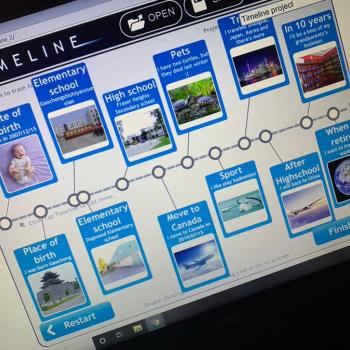
Creating timelines with this tool becomes an engaging activity for students as they choose from five different units of measure (date, time, event, entry, or other) and add specific descriptions of each entry. Once the entries have been added, students may navigate through any part of the timeline by simply clicking on the appropriate entry. Students may view and edit their draft timeline, then print the finished timeline for reference. This is a handy tool for classroom use that guides students through the process of organizing information in timeline form and results in a polished finished product. See a sample horizontal timeline for a student autobiography for an example of what a student's work might look like.
For additional ideas on how to use this tool outside of the classroom, see Timeline in the Parent & Afterschool Resources section.
Grades 6 – 8 | Lesson Plan | Standard Lesson
Memories Matter: The Giver and Descriptive Writing Memoirs
Using The Giver, students discuss the importance recorded history. This provides context for descriptive writing of students’ own history in a lesson that integrates personal writing, research, and literary response.
Grades 6 – 8 | Lesson Plan | Standard Lesson
Writing a Flashback and Flash-Forward Story Using Movies and Texts as Models
Using the film The Sandlot, students are introduced to the literary devices of flashbacks and flash-forwards. They then write their own stories using those devices.
Grades 6 – 8 | Lesson Plan | Standard Lesson
A Picture’s Worth a Thousand Words: From Image to Detailed Narrative
The old cliche, "A picture is worth a thousand words" is put to the test when students write their own narrative interpretations of events shown in an image.
Grades 6 – 8 | Lesson Plan | Unit
Discovering Memory: Li-Young Lee’s Poem “Mnemonic” and the Brain
Students learn about memory by doing a memory-writing exercise, studying the brain to understand how it affects memory, reading Li-Young Lee’s poem “Mnemonic,” and creating projects to demonstrate their understanding.
Grades 6 – 8 | Lesson Plan | Standard Lesson
Copyright Law: From Digital Reprints to Downloads
Students investigate how and why copyright law has changed over time, and apply this information to recent copyright issues, creating persuasive arguments based on the perspective of a particular group.
Grades 4 – 8 | Lesson Plan
Beyond History Books: Researching With Twin Texts and Technology
Students in grades 4–8 activate prior knowledge and research information about a historic event through fiction and nonfiction literature and exploration of relevant websites.
Grades 6 – 8 | Lesson Plan | Standard Lesson
Timelines and Texts: Motivating Students to Read Nonfiction
In an effort to help motivate students to read nonfiction, students are challenged to use a timeline to help them name the year when certain products were invented.
Grades 3 – 12 | Student Interactive | Organizing & Summarizing
The Graphic Map assists teachers and students in reading and writing activities by charting the high and low points related to a particular item or group of items, such as events during a day or chapters in a book.
Grades 1 – 12 | Student Interactive | Organizing & Summarizing
The Plot Diagram is an organizational tool focusing on a pyramid or triangular shape, which is used to map the events in a story. This mapping of plot structure allows readers and writers to visualize the key features of stories.
Grades 3 – 8 | Calendar Activity |  October 4
Edward Stratemeyer, creator of book series such as Nancy Drew, was born on this day in 1862.
Students select several books from one of Stratemeyer's series to read, discuss shared elements in the books, and use the 3-Circle Venn Diagram to compare story elements.
Grades 3 – 8 | Printout | Graphic Organizer
After students read a short story or chapter of a novel, they can use the Narrative Pyramid to reflect on key ideas and details.
![]()

