Graphic Organizer
Making Connections
Grades
3 - 8
Printout Type
Graphic Organizer
About this printout
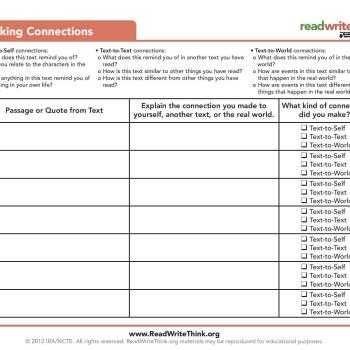
Using this printout, students make personal associations to a text by finding and describing text-to-text, text-to-self, and text-to-world connections.
Teaching with this printout
- Explain to students that they are going to practice the comprehension strategy of making connections to find ways that readers can personally relate to a text. Direct students to look at the questions at the top of the printout; explain to them that these questions can help them think about ways in which they can connect to the text that they are reading.
- Remind students of the three types of connections: Text-to-Self Connections, Text-to-Text Connections, and Text-to-World Connections (use the linked Making Connections Posters as an aid, if needed) . Explain how readers often make connections to a text to help them better understand the plot/storyline.
- Share examples of connections from a familiar text with students, making sure to emphasize connections that actually help enhance the understanding of the novel and others that are merely “there.”
- Good connections that enhance understanding:
- When I was in second grade, I moved to a new school like Shirley did. I remember feeling like everyone ignored me and missing my home, so I can relate to what she’s going through.
- Surface-level connections that are merely “there”:
- Shirley likes the Dodgers. So do I.
- Good connections that enhance understanding:
- Ask students to share a few quick examples of both kinds of connections (those that enhance understanding vs. those that are "there"), and explain why some might help their understanding of the text more than others.
- After you are certain that students have a firm understanding of making connections, allow them to begin listing their own connections using the printout (after completing a reading).
- Discuss students’ connections that they found within the text, either as a whole class or in partners or small groups.
More ideas to try
- Students can organize and write an essay about a connection to the text using the Essay Map interactive or choose a different student interactive to use to create a project based on a connection to the text.