The Magnetism of Language: Parts of Speech, Poetry, and Word Play

- Preview |
- Standards |
- Resources & Preparation |
- Instructional Plan |
- Related Resources |
- Comments
Overview
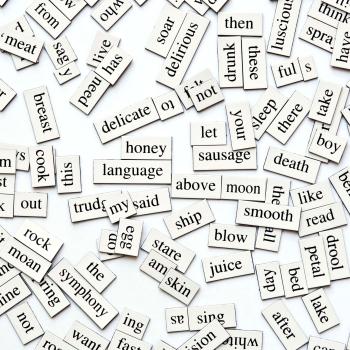
Adjectives, adverbs, nouns, and interjections: students will get a grammar overload in this lesson! Grammar can serve as a jumping-off point for exploring language. This lesson extends students' knowledge of parts of speech and encourages them to look critically at how language functions. Students begin with a review of the parts of speech. Using Lewis Carroll's poem "Jabberwocky," students look closely at the nonsensical words to identify their parts of speech and meaning. After experimenting with the Word Mover mobile application, they create their own magnetic poetry kits, which they use to both revise and reinterpret Carroll's poem and write their own original poems.
Lesson originally published in March 2007. Revised October 2012 by Christy Simon, NCTE staff.
Featured Resources
- Word Mover: Students can use this mobile application to help them create their own poetic masterpieces.
From Theory to Practice
- Roberts says about online magnetic poetry sites, "the engaging visuals replicate the idea of magnets on the refrigerator, so students are pleased with quick results."
- Writing is a journey that takes place in many phases. The computer can be used for all the stages of writing, from prewriting to the finished product.
- Students need to be "familiar with the syntax or grammatical function of the words and phrases they are reading and with their meanings."
- It is best to recognize words on sight. But, if that's not possible, having strategies on hand to aid with decoding and comprehension is important. Knowledge of the parts of speech is one such strategy.
"Students can become excited about language and how it works if the topic is presented in an active and engaging manner." Thus, word play and exploration is an important facet of a language arts program.
Common Core Standards
This resource has been aligned to the Common Core State Standards for states in which they have been adopted. If a state does not appear in the drop-down, CCSS alignments are forthcoming.
State Standards
This lesson has been aligned to standards in the following states. If a state does not appear in the drop-down, standard alignments are not currently available for that state.
NCTE/IRA National Standards for the English Language Arts
- 3. Students apply a wide range of strategies to comprehend, interpret, evaluate, and appreciate texts. They draw on their prior experience, their interactions with other readers and writers, their knowledge of word meaning and of other texts, their word identification strategies, and their understanding of textual features (e.g., sound-letter correspondence, sentence structure, context, graphics).
- 4. Students adjust their use of spoken, written, and visual language (e.g., conventions, style, vocabulary) to communicate effectively with a variety of audiences and for different purposes.
- 5. Students employ a wide range of strategies as they write and use different writing process elements appropriately to communicate with different audiences for a variety of purposes.
- 6. Students apply knowledge of language structure, language conventions (e.g., spelling and punctuation), media techniques, figurative language, and genre to create, critique, and discuss print and nonprint texts.
- 11. Students participate as knowledgeable, reflective, creative, and critical members of a variety of literacy communities.
- 12. Students use spoken, written, and visual language to accomplish their own purposes (e.g., for learning, enjoyment, persuasion, and the exchange of information).
Materials and Technology
- Tablet devices (i.e. iPad, Android) preloaded with the Word Mover mobile app
- Computers with Internet access
- Overhead transparencies and projector or LCD projector
- Laminating machine (optional)
- Scissors
- Colored paper
- Sandwich bags
- Magnetic poetry kit (optional)
- Magnetic tape (optional)
Printouts
Websites
This site includes a collection of Mad Libs for students to create and complete.
Preparation
| 1. | Students should be familiar with the parts of speech before beginning this lesson. Depending on how recently you have discussed them, you may choose to start Session One by reviewing them as appropriate for your class. You may also choose to teach one of the following lessons before beginning this one: |
| 2. | Download the Word Mover mobile application to both the teacher's tablet, as well as any tablets that students will be using. Additionally, reserve classroom or lab computers for the activities in Sessions One, Two, and Four. |
| 3. |
Visit and familiarize yourself with the Web Resources, deciding which, if any, to use with your students. Bookmark these sites on the computers students will be using. |
| 4. | Print off a copy of "Jabberwocky" by Lewis Carroll and make a copy for each student in your class. Make a transparency, project or copy the poem onto chart paper. |
| 5. | Make one copy of The Magnetism of Language Instruction Sheet, Wocky Mad Lib: Part 1, and Wocky Mad Lib: Part 2 handouts for each student in your class. |
| 6. | Assemble magnetic poetry kit materials: green, red, orange, blue, yellow, purple, and pink paper; scissors; and sandwich bags. You can also get magnetic tape, which has adhesive on one side and magnetic material on the other. You will need one roll for every two students; some rolls of tape are wide enough to fit the words in pairs. If you cannot get magnetic tape, it is sufficient that students' word lists be color-coded and laminated (see the beginning of Session Five). |
| 7. | If you have a magnetic poetry kit, bring it in for use during Session Two. |
Student Objectives
Students will:
- access prior knowledge by reviewing the parts of speech.
- demonstrate comprehension of the parts of speech by identifying them in a nonsensical poem and by creating their own word lists.
- think critically by identifying the strategies they use for interpreting the nonsensical poem and locating the parts of speech within it.
- understand that language can be played with by creating magnetic poetry kits that they use to reinterpret poems and write their own poem.
Session One
| 1. | Review the parts of speech with students, asking for examples until you are satisfied that students understand them sufficiently. You may want to have students brainstorm examples of each part of speech and write lists on the board that you leave up as examples for the duration of this lesson. |
| 2. | If you choose to do so, have students visit Wacky Web Tales. There is a collection of Mad Libs to choose from; each student should complete one or two stories. When they are finished, they should print the stories. |
| 3. | Gather students and have them share their Mad Libs with the class. You might also choose to have students do this in small groups. |
Session Two
| 1. | Lead a discussion about how manipulating English in strange ways can be humorous. A good place to start this discussion is asking students if they have ever had a slip of the tongue where they have said the wrong word with funny results. For example, you may say you asked your son to put dirty dishes in the washing machine. Ask students to offer their own examples. |
| 2. | Invite students to share if they have ever played with magnetic poetry. Spend a few minutes talking about what magnetic poetry is and what kinds of things they may have done with it. If you have brought in a magnetic poetry kit, put the pieces up on the board and invite students to make a few of their own quick poems. The Wacky Web Tales that students completed during Session One can also be good springboards for this discussion. |
| 3. | Pass out "Jabberwocky" by Lewis Carroll to the class. Read it aloud and discuss. What are students' first impressions of the poem? What is it about? Although it appears to be nonsense, is there anything that can help us to understand the poem? What? |
| 4. | Using the transparency, projection, or chart paper, go through the first stanza of the poem together, stopping at each unfamiliar word and asking students to identify its part of speech and possible meaning. Ask them to explain how they know what part of speech the word is. For example, the word the indicates that the following word will be a noun. You may want to point out that this poem also has an adjective-noun trend. |
| 5. | Talk about how context provides cues for meaning. For example, you might point out that it seems like the "jabberwocky," a noun, is some type of dangerous creature with "jaws that bite" and "claws that catch!" Biting and clawing are things a creature that attacks would do, and the very first line warns readers to "beware." In the same vein, a Jubjub bird must also be dangerous because the reader is also warned to "beware" of it. Finally, in the first stanza, readers are told to "shun the frumious Bandersnatch!" Because "frumious" comes before "Bandersnatch" we know that it is an adjective, and we can guess that it probably means something like "furious" since this creature is also included as a dangerous one to avoid. |
Session Four
| 1. | Pass out The Magnetism of Language Instruction Sheet and review. Students should complete Steps 1 through 3. |
| 2. |
Give students time to work on their word lists. Students who are having difficulty thinking of words may use books from the classroom library. They should use context clues and word knowledge to discern the parts of speech. While students work, circulate to offer help and to monitor for appropriateness. NOTE: For English-language learners or other learners with difficulty, it may help to have this portion of the work done in the computer lab so students may make use of Wacky Web Tales' Parts of Speech Help, a site to help students identify the parts of speech of words. |
Session Five
Before the beginning of this session, review students' lists and make sure words are appropriate and are categorized correctly. You may choose to mark words that are categorized incorrectly, return the lists to the students, and let them fix their mistakes before checking them again. Or you may simply mark the correct parts of speech on the lists.
| 1. | Return students' word lists. Instruct them to make any necessary changes. |
| 2. | Have students take out The Magnetism of Language Instruction Sheet; review Steps 4 through 6. |
| 3. | Students should type their word lists and turn them in. |
Session Six
Before the beginning of this session, make color-coded copies of students' word lists on construction paper as follows: green-conjunctions, red-adverbs, orange-interjections, blue-adjectives, yellow-nouns, purple-verbs, pink-pronouns, and grey-prepositions. Laminate the lists if possible.
| 1. | Pass the color-coded copies back to students. Give them scissors and magnetic tape and tell them to assemble their kits. When they are finished, they should store their words in sandwich bags for future use. |
| 2. | Before class is over, pass out the Wocky Mad Lib: Part 1 handout and review the instructions. If time permits, read "Jabberwocky" aloud to students once more. Have students complete the first part of the Wocky Mad Lib handout before the next session. |
Session Seven
| 1. | Pass out the Wocky Mad Lib: Part 2 handout and review the instructions. |
| 2. | Have students plug in the words they chose from their kits the night before. |
| 3. | Students should then get into their groups from Session Three and share their versions of "Jabberwocky." Each group should choose their favorite version of the poem. |
| 4. | Bring the class back together and have each group share the poem they have chosen. Discuss what students have learned about language and parts of speech. Questions for discussion include:
|
| 5. | If time allows, tell students to play with their word kits and create original poems; they should write down the poems and turn them in. Instead, they could also spend time writing poems on the Word Mover mobile app and then save, share, and/or print their poems. |
Session Three
- Have students get in five groups; assign each group a stanza (noting that the last stanza is the same as the first) and ask them to go through the stanza as they did as a class during yesterday’s session (looking at context clues). They should indicate parts of speech and possible meanings for unfamiliar words.
- Come together as a whole class and discuss. Students should come to the conclusion that the poem tells a story about a young man slaying an imaginary beast or animal. Explain to them that this is a narrative poem.
- Ask students to write a one-to-two-paragraph summary of what the poem is about and what they have learned about the language from the reading and discussion of the poem. Collect these summaries for assessment.
- For the remainder of class, have students explore the Word Mover mobile app on their tablets. They can use the words to make their own nonsense poems, adding new words as they choose.
Extensions
- Students can use their kits to learn about sentence fragments. Ask them to make sentence fragments by purposefully leaving out subjects, verbs, or both. This reinforces the connectedness of grammar; knowing the parts of speech helps students identify sentence fragments.
- Students can also create their own Mad Libs and have other students use their poetry kits to fill them in.
- Students can use their kits or the mobile app to create story starters.
- Students can use the words from their kits to make a crossword puzzle with the online Crossword Puzzle tool. Clues can include hints about the word that include what part of speech it is. Students can solve each other's puzzles online or print and swap puzzles. See Creating Puzzles: A Guide for Teachers for more information.
Student Assessment / Reflections
- Informally observe discussions and student responses to see how well students understand parts of speech and how to use them. Assist individual students as needed.
- Checklist for The Magnetism of Language Instruction Sheet assignment:
- Did the student complete the number requirements for each part of speech?
- Were the words sorted appropriately according to parts of speech?
- Did the student check spelling?
- Did the student create a magnetic poetry kit?
- Was the kit neatly put together?
- Did the student complete the number requirements for each part of speech?
- Checklist for reflection on “Jabberwocky”:
- Did the student have an understanding of what the poem was about?
- Did the student reflect on the strategies he or she used to comprehend the poem?
- Did the student understand how knowing the parts of speech helped to understand the poem?
- Did the student complete both the Wocky Mad Lib: Part 1 and Wocky Mad Lib: Part 2 assignments?
- Did the student gain an appreciation for playing with the language, as demonstrated in class discussion and in creating original poetry?
- Did the student have an understanding of what the poem was about?
Add new comment