This tool allows students to create an online K-W-L chart. Saving capability makes it easy for them to start the chart before reading and then return to it to reflect on what they learned.
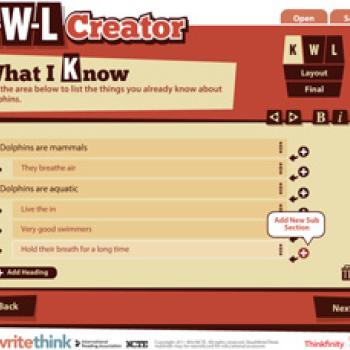
K-W-L Creator

Crossword Puzzles
This tool allows students to complete crossword puzzles on a variety of grade-appropriate topics, and also create and print their own crossword puzzles.
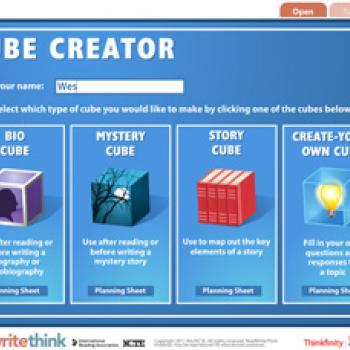
Bio Cube
Bio Cube is a useful summarizing tool that helps students identify and list key elements about a person for a biography or autobiography.
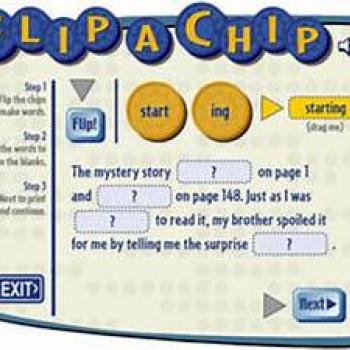
Flip-a-Chip
The Flip-a-Chip activity provides hands-on practice with affixes and roots, and also promotes comprehension through structural analysis and vocabulary in context.
Eye on Idioms
The activity includes a series of exercises, in which students view the literal representations of idioms and then examine the metaphorical meanings of the idioms.
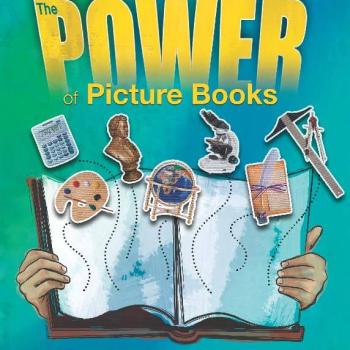
Power of Picture Books, The: Using Content Area Literature in Middle School
Featuring descriptions and activities for fifty exceptional titles, Mary Jo Fresch and Peggy Harkins offer a wealth of ideas for harnessing the power of picture books to improve reading and writing in the content areas.
I-Search in the Age of Information
Middle school teacher Huntington Lyman takes a fresh look at the I-Search research method and shows how it can be modified to provide an effective project for middle school students.
Technology That Powers Up Learning
By designing lessons to activate prior knowledge and linking these activities to reading and writing, teachers found that students were more engaged, that they learned more material more quickly, and that they more willingly incorporated reading into their lives.

Tim O'Brien in the Classroom: "This too is true: Stories can save us"
As part of the NCTE High School Literature Series, Tim O'Brien in the Classroom focuses on opportunities for classroom discussion and writing assignments, including lessons, open-ended prompts, and student writing samples.
Nonfiction Roundup
With each annual crop of new nonfiction, teens have the opportunity to discover and explore new disciplinary worlds. Tune in to hear about an array of recently-published nonfiction titles that will engage teens in learning about history, science, economics, and medicine. You'll hear about junk food and advertising, the atomic bomb and civil rights, bird watching and volcanoes – books written in a variety of formats for a variety of teen readers.
Adults and Teens Reading Together
Tune in to hear about eight new novels that all focus in some way on teens and their complicated relationships with family members, peers, and the larger world.
A Conversation with Sara Zarr
Tune in to hear Sara Zarr discuss religious faith and some of the thinking behind her newest novel, Once Was Lost.
Exploring History
Hear about an amazing range of books that explore history, including works of fiction as well as non-fiction, biographies, graphic novels, verse novels, and investigative journalism.

Connection Stems
Connection Stems give students the language (and a reminder) to support their understanding by tying new learning to what they know about themselves and their world.

K-W-L-S Chart
This printable extends the familiar K-W-L's means of organizing students' prior knowledge, formulating inquiry questions, and recording new learning by adding space for questions for further inquiry.

Venn Diagram, 3 Circles
Students use this graphic organizer to describe similarities and differences between three objects or ideas.

I-Search Chart
As part of an I-Search writing process, this handout facilitates the formation of meaningful questions and subquestions for student inquiry.
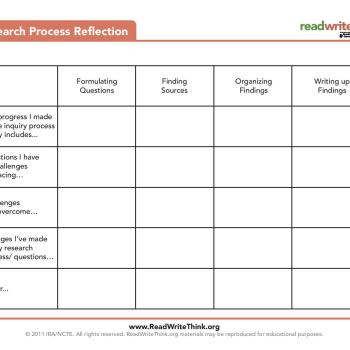
I-Search Process Reflection Chart
This chart asks students to consider their challenges and successes across the span of the research process, from question formulation to the final write-up.

I-Chart
This printout assists students with generating meaningful questions about a topic and organizing their writing by using a structured guide while researching.