This guide explores quantitative civic reasoning in English and math classrooms.
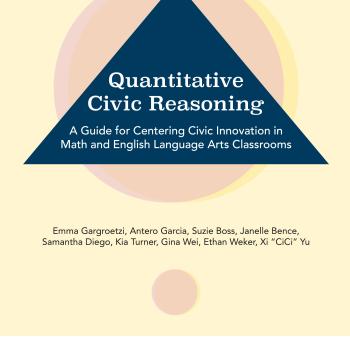
Quantitative Civic Reasoning: A Guide for Centering Civic Innovation in Math and English Language Arts Classrooms
2025 NCTE Annual Convention
Each November thousands of literacy educators from across the country make the journey to a Convention that inspires their practice and rejuvenates their profession.
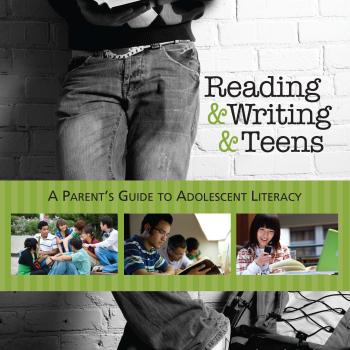
Reading & Writing & Teens: A Parent's Guide to Adolescent Literacy
Offering advice from a host of experts in adolescent literacy, this book helps answer real questions from parents across the country about how to best support their teens as readers and writers.

Tim O'Brien in the Classroom: "This too is true: Stories can save us"
As part of the NCTE High School Literature Series, Tim O'Brien in the Classroom focuses on opportunities for classroom discussion and writing assignments, including lessons, open-ended prompts, and student writing samples.
A Failure of the Imagination
This article discusses the imaginative activities and assignments that teachers often assign that violate the text around which the lesson is focused and that mislead students about its meaning.

Introducing New Content with Seed Discussions
In this strategy guide, you'll learn how to elicit ideas and conversation about new concepts or content by effectively holding a Seed Discussion in your classroom.

Brainstorming and Reviewing Using the Carousel Strategy
This strategy guide introduces Carousel Brainstorming, also known as Rotating Review, and offers suggestions to implement this technique in your classroom for brainstorming about new topics or reviewing learned information.

Using the RAFT Writing Strategy
This strategy guide introduces the RAFT technique and offers practical ideas for using this technique to teach students to experiment with various perspectives in their writing.

Socratic Seminars
This strategy guide explains Socratic seminars and offers practical methods for applying the approach in your classroom to help students investigate multiple perspectives in a text.

Supporting Student Comprehension in Content Area Reading
In this strategy guide, you'll learn a few simple, yet powerful, techniques to encourage students to use peer talk and writing to enhance their understanding of content area texts.

Preparing Students for Success with Reading in the Content Areas
In this strategy guide, you'll learn how to determine the level and type of support you need to provide students based on careful preparation as a content area expert.

Reading with Purpose in the Content Areas
In this strategy guide, you'll learn how to organize students and instruction to establish a sense of purpose for reading authentic texts in the content areas.

Promoting Student Self-Assessment
In this Strategy Guide, you'll learn about a number of specific methods that will promote self-assessment and contribute to a richer understanding of student learning.

Teaching With Multiple Modalities
In this Strategy Guide, you'll see how one lesson utilizes tiered texts and multiple modalities in order to meet the learning style needs of students.
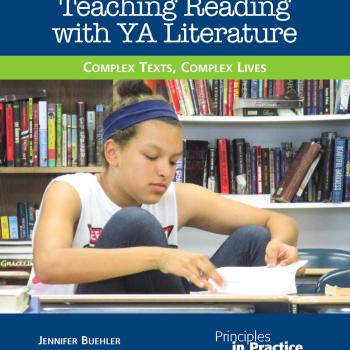
Teaching Reading with YA Literature: Complex Texts, Complex Lives
This book is designed to help teachers develop their own version of YA pedagogy and a vision for teaching YA lit in the middle and secondary classroom.

Facilitating Participation with Silent Conversations
This guide introduces silent conversations, a collaborative learning technique that has students
thinking, sharing, and reflecting about important questions—but through writing rather than talk.

Consensus Decision Making
This strategy guide introduces Consensus Decision Making, a method for facilitating and engaging students in a critical discussion of the central ideas of a text.

Close Reading of Literary Texts
This guide provides strategies for choosing text that is appropriate for close reading and to plan for instruction.

Reading on the Go
In this Strategy Guide, learn how to prepare yourself and your students for reading and note-taking in mobile environments.

Making the Reading Process Visible through Performance Assessment
Effective differentiation begins with purposeful assessment. In this strategy guide, you'll learn how to construct an authentic performance-based reading assessment that will give you access to students' thinking before, during, and after reading.