Using The Giver, students discuss the importance recorded history. This provides context for descriptive writing of students' own history in a lesson that integrates personal writing, research, and literary response.

Memories Matter: The Giver and Descriptive Writing Memoirs
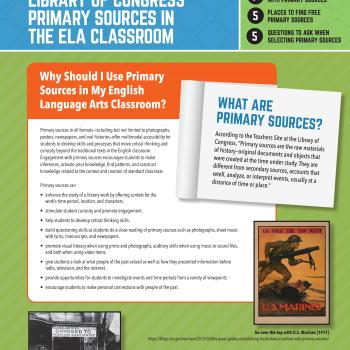
Engaging Students with Library of Congress Primary Sources in the ELA Classroom Quick-Reference Guide (QRG)
Quick-Reference Guide (QRG) focused on "Engaging Students with Library of Congress Primary Sources in the ELA Classroom."
Quantitative Civic Reasoning: A Guide for Centering Civic Innovation in Math and English Language Arts Classrooms
This guide explores quantitative civic reasoning in English and math classrooms.

Rosa Parks was born on this day in 1913.
Rosa Parks was committed to the struggle for social justice and human rights until her death, inspiring millions of people around the world. Today, we celebrate her!
2025 NCTE Annual Convention
Each November thousands of literacy educators from across the country make the journey to a Convention that inspires their practice and rejuvenates their profession.
Fact Fragment Frenzy
Fact Fragment Frenzy provides elementary students with an online model for finding facts in nonfiction text, then invites students to find facts in five sample passages.
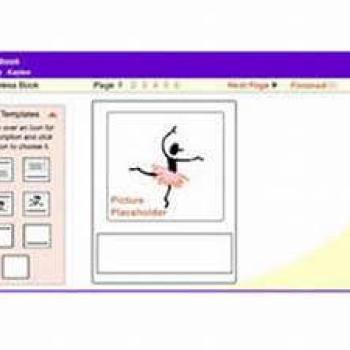
Stapleless Book
The Stapleless Book can be used for taking notes while reading, making picture books, collecting facts, or creating vocabulary booklets . . . the possibilities are endless!
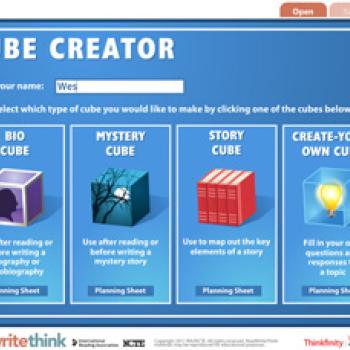
Cube Creator
The interactive Cube Creator helps students identify and summarize key elements. It can be used as a prewriting or postreading activity.
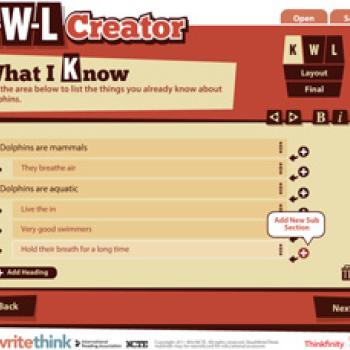
K-W-L Creator
This tool allows students to create an online K-W-L chart. Saving capability makes it easy for them to start the chart before reading and then return to it to reflect on what they learned.

Crossword Puzzles
This tool allows students to complete crossword puzzles on a variety of grade-appropriate topics, and also create and print their own crossword puzzles.
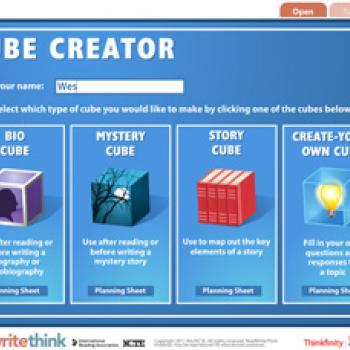
Bio Cube
Bio Cube is a useful summarizing tool that helps students identify and list key elements about a person for a biography or autobiography.
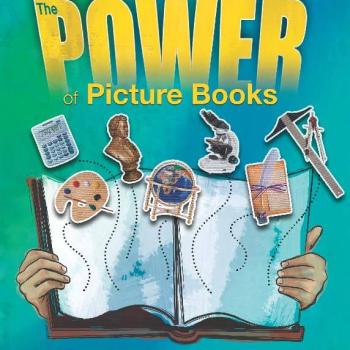
Power of Picture Books, The: Using Content Area Literature in Middle School
Featuring descriptions and activities for fifty exceptional titles, Mary Jo Fresch and Peggy Harkins offer a wealth of ideas for harnessing the power of picture books to improve reading and writing in the content areas.
I-Search in the Age of Information
Middle school teacher Huntington Lyman takes a fresh look at the I-Search research method and shows how it can be modified to provide an effective project for middle school students.
Technology That Powers Up Learning
By designing lessons to activate prior knowledge and linking these activities to reading and writing, teachers found that students were more engaged, that they learned more material more quickly, and that they more willingly incorporated reading into their lives.

Tim O'Brien in the Classroom: "This too is true: Stories can save us"
As part of the NCTE High School Literature Series, Tim O'Brien in the Classroom focuses on opportunities for classroom discussion and writing assignments, including lessons, open-ended prompts, and student writing samples.
Violent Red, Ogre Green, and Delicious White: Expanding Meaning Potential through Media
This article reports on the meaning potential of daily access to drawing/writing media for widening and deepening meaning construction.
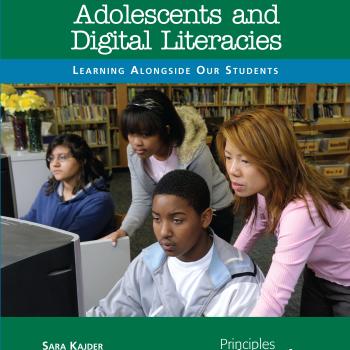
Adolescents and Digital Literacies: Learning Alongside Our Students
This book isn't about technology. It's about the teaching practices that technology enables. This book addresses the ways in which teachers and students work together to navigate continuous change and what it means to read, write, view, listen, and communicate in the twenty-first century.
A Conversation with Sara Zarr
Tune in to hear Sara Zarr discuss religious faith and some of the thinking behind her newest novel, Once Was Lost.

K-W-L-S Chart
This printable extends the familiar K-W-L's means of organizing students' prior knowledge, formulating inquiry questions, and recording new learning by adding space for questions for further inquiry.