This chart asks students to consider their challenges and successes across the span of the research process, from question formulation to the final write-up.
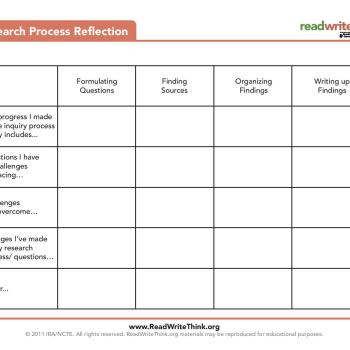
I-Search Process Reflection Chart

Haiku Starter
This graphic organizer provides students the opportunity to brainstorm words about a given topic, count and record the syllables, and draft a haiku.

RAFT Writing Template
Students can utilize this printout to organize their writing as they learn to use the RAFT strategy. This printout enables students to clearly define their role, audience, format, and topic for writing.

Persuasion Map
Use this graphic organizer to develop a persuasive stance for an essay, speech, poster, or any type of assignment that incorporates persuasion.

Editing Checklist for Self- and Peer Editing
This helpful tool will give your students the opportunity to edit their own writing and then observe as their peers edit the same work.

Essay Rubric
This rubric delineates specific expectations about an essay assignment to students and provides a means of assessing completed student essays.

Diamante Poem
This tool will allow your students to create a diamante poem by reflecting on their knowledge of a topic and by using nouns, verbs, and adjectives in a creative manner.

Essay Map
Use this graphic organizer to develop an outline for an essay that includes an introductory statement, main ideas, supporting details, and a conclusion.

Finding the YA Community at NCTE Convention
Tune in to hear about specific things you can do to find the YA community at NCTE Annual Convention. You'll learn about the kinds of YA lit sessions that typically appear on the program, and you'll hear tips from YA advocates about how to make the most of the opportunity to meet authors, discover new books, and connect with others who love young adult literature as much as you do.

Brainstorming and Reviewing Using the Carousel Strategy
This strategy guide introduces Carousel Brainstorming, also known as Rotating Review, and offers suggestions to implement this technique in your classroom for brainstorming about new topics or reviewing learned information.

Using the Think-Pair-Share Technique
In this strategy guide, you will learn how to organize students and classroom topics to encourage a high degree of classroom participation and assist students in developing a conceptual understanding of a topic through the use of the Think-Pair-Share technique.

Using the RAFT Writing Strategy
This strategy guide introduces the RAFT technique and offers practical ideas for using this technique to teach students to experiment with various perspectives in their writing.

Socratic Seminars
This strategy guide explains Socratic seminars and offers practical methods for applying the approach in your classroom to help students investigate multiple perspectives in a text.

Using the Jigsaw Cooperative Learning Technique
In this strategy guide, you will learn how to organize students and texts to allow for learning that meets the diverse needs of students but keeps student groups flexible.

Supporting Student Comprehension in Content Area Reading
In this strategy guide, you'll learn a few simple, yet powerful, techniques to encourage students to use peer talk and writing to enhance their understanding of content area texts.

Peer Review
This strategy guide explains how you can employ peer review in your classroom, guiding students as they offer each other constructive feedback to improve their writing and communication skills.

Persuasive Writing
This strategy guide focuses on persuasive writing and offers specific methods on how you can help your students use it to improve their critical writing and thinking skills.

Promoting Student Self-Assessment
In this Strategy Guide, you'll learn about a number of specific methods that will promote self-assessment and contribute to a richer understanding of student learning.

Assessing Student Interests and Strengths
In this Strategy Guide, you'll learn about a number of specific methods that can help you to gain a fuller picture of the interests of your students as well as what your students understand, know, and can demonstrate by doing.

Evidence-based Discussions
These Strategy Guides offer varied ways to support students as they develop the skills and habits necessary to participate in evidence-based conversations.