This chart asks students to consider their challenges and successes across the span of the research process, from question formulation to the final write-up.
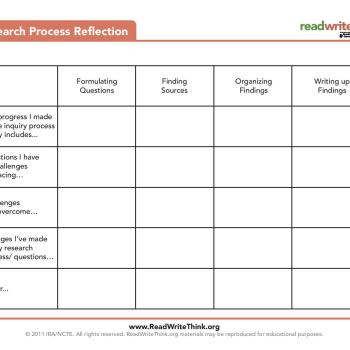
I-Search Process Reflection Chart

I-Chart
This printout assists students with generating meaningful questions about a topic and organizing their writing by using a structured guide while researching.

Exit Slips
This printout provides prompts that help students reflect on and process new information and think critically, and offers teachers the opportunity to differentiate upcoming instruction based on these reflections.

Connection Web
Students use this printout to expand on connections they have made to a text and use those details to write essays or create projects about the text.
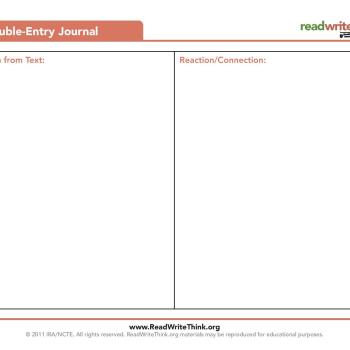
Double-Entry Journal
This printout helps students record ideas and situations from texts in one column, and their reactions in the second, thus making a connection between the text and themselves, another text, or the world.

RAFT Writing Template
Students can utilize this printout to organize their writing as they learn to use the RAFT strategy. This printout enables students to clearly define their role, audience, format, and topic for writing.

Seed Discussion Organizer
Students can utilize this printout to organize their thoughts as a new concept or content is introduced through a Seed Discussion. This printout readies students to acquire new knowledge by organizing what they know and what they're prepared to learn.

Anticipation Guide
Help establish a purpose for reading—and generate post-reading reflection and discussion—with this guide.

K-W-L Chart
This K-W-L Chart, which tracks what a student knows (K), wants to know (W), and has learned (L) about a topic, can be used before, during, and after research projects.

Making Connections
In this strategy guide, you'll learn to model how students can make three different kinds of connections (text-to-text, text-to-self, text-to-world). Students then use this knowledge to find their own personal connections to a text.

Introducing New Content with Seed Discussions
In this strategy guide, you'll learn how to elicit ideas and conversation about new concepts or content by effectively holding a Seed Discussion in your classroom.

Brainstorming and Reviewing Using the Carousel Strategy
This strategy guide introduces Carousel Brainstorming, also known as Rotating Review, and offers suggestions to implement this technique in your classroom for brainstorming about new topics or reviewing learned information.

Using the Think-Pair-Share Technique
In this strategy guide, you will learn how to organize students and classroom topics to encourage a high degree of classroom participation and assist students in developing a conceptual understanding of a topic through the use of the Think-Pair-Share technique.

Using the RAFT Writing Strategy
This strategy guide introduces the RAFT technique and offers practical ideas for using this technique to teach students to experiment with various perspectives in their writing.

Socratic Seminars
This strategy guide explains Socratic seminars and offers practical methods for applying the approach in your classroom to help students investigate multiple perspectives in a text.

Using the Jigsaw Cooperative Learning Technique
In this strategy guide, you will learn how to organize students and texts to allow for learning that meets the diverse needs of students but keeps student groups flexible.

Persuasive Writing
This strategy guide focuses on persuasive writing and offers specific methods on how you can help your students use it to improve their critical writing and thinking skills.

Supporting Comprehension Strategies for English Language Learners
This Strategy Guide is for developing comprehension that incorporates the gradual release of responsibility model.

Supporting Vocabulary Acquisition for English Language Learners
This Strategy Guide introduces strategies teachers can use for ELL vocabulary instruction in their English and content area classrooms.

Promoting Student Self-Assessment
In this Strategy Guide, you'll learn about a number of specific methods that will promote self-assessment and contribute to a richer understanding of student learning.