ReadWriteThink - Powered by NCTE
  • About
  • Classroom Resources
    • Lesson Plans
    • Teaching Comics
    • Teaching With Primary Resources
    • Calendar
    • Printouts
    • Student Interactives
  • Collections
    • Assessment
    • Authors
    • Booklists
    • Media Literacy
    • Poetry
    • Primary Sources
    • Writing
  • Professional Development
    • Strategy Guides
    • Professional Library
    • Meetings & Events
  • Join NCTE
  • Contact Us
  • About
  • Classroom Resources
    • Lesson Plans
    • Teaching Comics
    • Teaching With Primary Resources
    • Calendar
    • Printouts
    • Student Interactives
  • Collections
    • Assessment
    • Authors
    • Booklists
    • Media Literacy
    • Poetry
    • Primary Sources
    • Writing
  • Professional Development
    • Strategy Guides
    • Professional Library
    • Meetings & Events
  • Join NCTE
  • Contact Us
  • Facebook
  • Twitter
  • Instagram
  • Pinterest
  • YouTube

Breadcrumb

  1. Home

Type

  • (-) Professional Development
    • Professional Library
    • Strategy Guide

Grades

  • 1 (1)
  • 2 (1)
  • 3 (2)
  • 4 (3)
  • 5 (5)
  • 6 (7)
  • 7 (7)
  • 8 (7)
  • 9 (6)
  • 10 (6)
  • 11 (6)
  • 12 (6)
  • K (1)

Learning Objectives

  • (-) metacognition (8)
  • collaboration (6)
  • Comprehension (6)
  • critical thinking (9)
  • digital literacy (3)
  • inquiry / research (6)
  • listening (4)
  • literary analysis (2)
  • Media literacy (4)
  • multimodal literacy (5)
  • oral communication (9)
  • reading fluency (1)
  • text structure / story structure (1)
  • Vocabulary (2)
  • writing genres (5)
  • writing process (2)

Topics

  • (-) community
  • arts
  • careers
  • drama
  • Family
  • fiction
  • Mathematics
  • nonfiction
  • poetry
  • science
  • seasons / holidays
  • social action
  • Sports
  • STEM
Quantitative Civic Reasoning
Grades
4 - 12
|
Professional Library
|
Professional Library
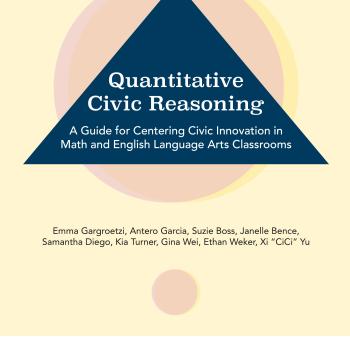
Quantitative Civic Reasoning: A Guide for Centering Civic Innovation in Math and English Language Arts Classrooms

This guide explores quantitative civic reasoning in English and math classrooms.
Making Connections
Grades
Grades
3 - 8
|
Strategy Guide
Making Connections
In this strategy guide, you'll learn to model how students can make three different kinds of connections (text-to-text, text-to-self, text-to-world). Students then use this knowledge to find their own personal connections to a text.

Using the RAFT Writing Strategy
Grades
Grades
5 - 12
|
Strategy Guide
Using the RAFT Writing Strategy
This strategy guide introduces the RAFT technique and offers practical ideas for using this technique to teach students to experiment with various perspectives in their writing.

Socratic Seminars
Grades
Grades
6 - 12
|
Strategy Guide
Socratic Seminars
This strategy guide explains Socratic seminars and offers practical methods for applying the approach in your classroom to help students investigate multiple perspectives in a text.

Persuasive Writing
Grades
Grades
K - 5
|
Strategy Guide
Persuasive Writing
This strategy guide focuses on persuasive writing and offers specific methods on how you can help your students use it to improve their critical writing and thinking skills.
Assessing Student Interests and Strengths
Grades
Grades
6 - 12
|
Strategy Guide
Assessing Student Interests and Strengths
In this Strategy Guide, you'll learn about a number of specific methods that can help you to gain a fuller picture of the interests of your students as well as what your students understand, know, and can demonstrate by doing.
Facilitating Participation with Silent Conversations
Grades
Grades
5 - 12
|
Strategy Guide
Facilitating Participation with Silent Conversations
This guide introduces silent conversations, a collaborative learning technique that has students thinking, sharing, and reflecting about important questions—but through writing rather than talk.
Conducting Inner-Outer Circle Discussions
Grades
Grades
6 - 12
|
Strategy Guide
Conducting Inner-Outer Circle Discussions
This guide shares the steps to take to get more students talking by dividing the group into speaking and non-speaking circles.

Explore Resources by Grade

  • KindergartenK
  • 1-2
  • 3-4
  • 5-6
  • 7-8
  • 9-10
  • 11-12

RWT-logo

Powered By NCTE

Footer 1 Menu

  • About
  • Classroom Resources
  • Professional Development
  • Collections
  • Contact Us

Footer 2 Menu

  • National Council of Teachers of English
  • Contribute to RWT
  • FAQs
  • Join NCTE

Footer 3 Menu

  • Legal Notices
  • Privacy Policy
  • Promotional Materials
  • Site Demonstrations

Want to stay in touch with RWT and NCTE? Sign up here!

  • Facebook
  • Twitter
  • Instagram
  • Pinterest
  • YouTube

© NCTE 2026. All rights reserved