ReadWriteThink - Powered by NCTE
  • About
  • Classroom Resources
    • Lesson Plans
    • Teaching Comics
    • Teaching With Primary Resources
    • Calendar
    • Printouts
    • Student Interactives
  • Collections
    • Assessment
    • Authors
    • Booklists
    • Media Literacy
    • Poetry
    • Primary Sources
    • Writing
  • Professional Development
    • Strategy Guides
    • Professional Library
    • Meetings & Events
  • Join NCTE
  • Contact Us
  • About
  • Classroom Resources
    • Lesson Plans
    • Teaching Comics
    • Teaching With Primary Resources
    • Calendar
    • Printouts
    • Student Interactives
  • Collections
    • Assessment
    • Authors
    • Booklists
    • Media Literacy
    • Poetry
    • Primary Sources
    • Writing
  • Professional Development
    • Strategy Guides
    • Professional Library
    • Meetings & Events
  • Join NCTE
  • Contact Us
  • Facebook
  • Twitter
  • Instagram
  • Pinterest
  • YouTube

Breadcrumb

  1. Home

Type

  • (-) Classroom Resources
    • Calendar Activity
    • Lesson Plan
    • Student Interactive

Grades

  • 1 (25)
  • 2 (25)
  • 5 (21)
  • 6 (13)
  • 7 (12)
  • 8 (12)
  • 9 (7)
  • 10 (7)
  • 11 (7)
  • 12 (7)
  • K (24)
  • (-) 4 (22)

Learning Objectives

  • (-) reading fluency (22)
  • collaboration (153)
  • Comprehension (147)
  • critical thinking (192)
  • digital literacy (33)
  • Grammar (13)
  • inquiry / research (114)
  • listening (61)
  • literary analysis (86)
  • Media literacy (47)
  • metacognition (102)
  • multicultural awareness (34)
  • multimodal literacy (62)
  • oral communication (59)
  • phonological awareness (10)
  • print awareness (24)
  • reading genres (65)
  • Spelling (12)
  • text structure / story structure (94)
  • Vocabulary (57)
  • writing genres (112)
  • writing process (118)

Topics

  • arts
  • careers
  • community
  • drama
  • ELL
  • Family
  • fiction
  • Mathematics
  • Mobile Learning
  • nonfiction
  • poetry
  • science
  • seasons / holidays
  • social action
  • social studies / history
ReadAcrossAmerica
Grades
K - 12
|
Calendar Activity
|
Literacy-Related Event
Read Across America Day: Celebrate a Nation of Diverse Readers

Bring the celebration of reading and literacy into your classroom, library, school, and home all year long.
K-W-L Creator
Grades
3 - 8
|
Student Interactive
|
Organizing & Summarizing
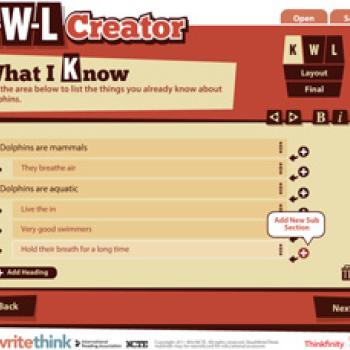
K-W-L Creator

This tool allows students to create an online K-W-L chart. Saving capability makes it easy for them to start the chart before reading and then return to it to reflect on what they learned.
Word Family Sort
Grades
K - 5
|
Student Interactive
|
Learning About Language
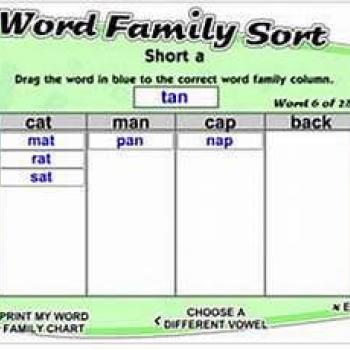
Word Family Sort

This online activity helps students recognize word patterns by having them sort a series of words into short-vowel word families.

Earth Verse: Using Science in Poetry
Grades
3 - 5
|
Lesson Plan
|
Standard Lesson
Earth Verse: Using Science in Poetry

Students shape up their reading, writing, and listening skills in this lesson by creating original diamante, acrostic, and shape poems about science.

Grades
3 - 5
|
Lesson Plan
|
Standard Lesson
Thoughtshots Can Bring Your Characters to Life!
Students will walk a mile in the shoes of Solomon Singer as they learn how to use flashbacks, flash-aheads, and internal dialogue to develop realistic characters.
Grades
3 - 5
|
Lesson Plan
|
Standard Lesson
Solving the Math Curse: Reading and Writing Math Word Problems
Students' reading, writing, listening, and speaking skills add up as they decipher word problems and use what they've learned to solve a crossword puzzle.
Sequencing: A Strategy to Succeed at Reading Comprehension
Grades
3 - 5
|
Lesson Plan
|
Standard Lesson
Sequencing: A Strategy to Succeed at Reading Comprehension
Did Paul Bunyan gouge out the Grand Canyon before or after he dug the Great Lakes? Students create a life-sized timeline showing the sequence of events in this tall tale.

Using Story Innovation to Teach Fluency, Vocabulary, and Structure
Grades
3 - 6
|
Lesson Plan
|
Recurring Lesson
Using Story Innovation to Teach Fluency, Vocabulary, and Structure
An instructional strategy called story innovation teaches students fluency, comprehension, vocabulary, and story structure. This unique strategy can be adapted for many purposes.
What's Under the Slide? Making Inferences Using Microscopes
Grades
3 - 5
|
Lesson Plan
|
Minilesson
What's Under the Slide? Making Inferences Using Microscopes
Students hone their critical thinking skills by learning how to make inferences from textual clues.

Going Digital: Using e-Book Readers to Enhance the Reading Experience
Grades
2 - 4
|
Lesson Plan
|
Standard Lesson
Going Digital: Using e-Book Readers to Enhance the Reading Experience
Students use various tools and features of digital readers to develop vocabulary, support comprehension, respond to text, improve fluency, and enhance the reading experience.

Reading Idol! Bringing Readers Theatre Center Stage in Your Classroom
Grades
3 - 5
|
Lesson Plan
|
Standard Lesson
Reading Idol! Bringing Readers Theatre Center Stage in Your Classroom
Students produce a Readers Theatre performance to compete to be named the Reading Idol. Students vote on the final performances and record them as podcasts.

Using Word Storms to Explore Vocabulary and Encourage Critical Thinking
Grades
3 - 5
|
Lesson Plan
|
Recurring Lesson
Using Word Storms to Explore Vocabulary and Encourage Critical Thinking
Students learn that dogs are more than just pets in this lesson, which teaches them to use research and vocabulary-acquisition strategies to learn and write about working dogs.

Nature Reflections: Interactive Language Practice for English-Language Learners
Grades
3 - 5
|
Lesson Plan
|
Unit
Nature Reflections: Interactive Language Practice for English-Language Learners
Students whose first language is not English reflect on nature through readings, a visit to a green area, and bookmaking using the writing process and peer feedback.

Buzz! Whiz! Bang! Using Comic Books to Teach Onomatopoeia
Grades
3 - 5
|
Lesson Plan
|
Standard Lesson
Buzz! Whiz! Bang! Using Comic Books to Teach Onomatopoeia
This lesson is sure to sizzle, not fizzle, as students use comic strips to find onomatopoetic words, develop a vocabulary list from the words, and discuss why writers use onomatopoeia.
Developing Searching, Skimming, and Scanning Skills With Internet Bingo
Grades
4 - 8
|
Lesson Plan
|
Standard Lesson
Developing Searching, Skimming, and Scanning Skills With Internet Bingo
Student pairs aim to be the first team to call out "bingo" in this lesson in which they use skimming and scanning to locate information about ancient Greece and Rome.
Writing a Movie: Summarizing and Rereading a Film Script
Grades
3 - 5
|
Lesson Plan
|
Standard Lesson
Writing a Movie: Summarizing and Rereading a Film Script
Lights! Camera! Action! In this lesson, students view a scene with no dialogue from E.T., write a script for that scene, and perform a dramatic reading while the scene plays.

Readers Theatre
Grades
3 - 5
|
Lesson Plan
|
Recurring Lesson
Readers Theatre
Students develop scripts, perform, and use their voices to depict characters from texts, giving them the opportunity to develop fluency and further enhance comprehension of what they are reading.
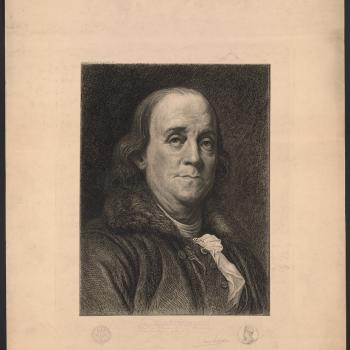
History Comes Alive: Developing Fluency and Comprehension Using Social Studies
Grades
2 - 5
|
Lesson Plan
|
Unit
History Comes Alive: Developing Fluency and Comprehension Using Social Studies
Let the power of imagination and inference serve as a "time machine" to bring Benjamin Franklin into the classroom! History and science come to life in a dialogue with Franklin the inventor, developed through lesson activities that incorporate research, imagination, writing, visual arts, and drama.
Multipurpose Poetry: Introducing Science Concepts and Increasing Fluency
Grades
3 - 5
|
Lesson Plan
|
Standard Lesson
Multipurpose Poetry: Introducing Science Concepts and Increasing Fluency

Creepy crawlers, hoppers, and fliers are the focus of this lesson in which students chorally read poems about insects and use the Internet to locate facts about their assigned insects.

Poetry: A Feast to Form Fluent Readers
Grades
3 - 5
|
Lesson Plan
|
Standard Lesson
Poetry: A Feast to Form Fluent Readers
Students improve their reading fluency by selecting a poem online to perform in class.

Pagination

  • Page 1
  • Page 2
  • Next page ››
  • Last page Last »

Explore Resources by Grade

  • KindergartenK
  • 1-2
  • 3-4
  • 5-6
  • 7-8
  • 9-10
  • 11-12

RWT-logo

Powered By NCTE

Footer 1 Menu

  • About
  • Classroom Resources
  • Professional Development
  • Collections
  • Contact Us

Footer 2 Menu

  • National Council of Teachers of English
  • Contribute to RWT
  • FAQs
  • Join NCTE

Footer 3 Menu

  • Legal Notices
  • Privacy Policy
  • Promotional Materials
  • Site Demonstrations

Want to stay in touch with RWT and NCTE? Sign up here!

  • Facebook
  • Twitter
  • Instagram
  • Pinterest
  • YouTube

© NCTE 2026. All rights reserved