This helpful tool will give your students the opportunity to edit their own writing and then observe as their peers edit the same work.

Editing Checklist for Self- and Peer Editing
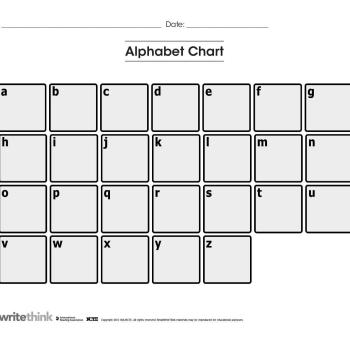
Alphabet Chart
This alphabet chart has many possibilities for helping your students learn and review their letters, sounds, phonemes, and word formations.

Finding the YA Community at NCTE Convention
Tune in to hear about specific things you can do to find the YA community at NCTE Annual Convention. You'll learn about the kinds of YA lit sessions that typically appear on the program, and you'll hear tips from YA advocates about how to make the most of the opportunity to meet authors, discover new books, and connect with others who love young adult literature as much as you do.

Making Connections
In this strategy guide, you'll learn to model how students can make three different kinds of connections (text-to-text, text-to-self, text-to-world). Students then use this knowledge to find their own personal connections to a text.

Introducing New Content with Seed Discussions
In this strategy guide, you'll learn how to elicit ideas and conversation about new concepts or content by effectively holding a Seed Discussion in your classroom.

Brainstorming and Reviewing Using the Carousel Strategy
This strategy guide introduces Carousel Brainstorming, also known as Rotating Review, and offers suggestions to implement this technique in your classroom for brainstorming about new topics or reviewing learned information.

Using the Think-Pair-Share Technique
In this strategy guide, you will learn how to organize students and classroom topics to encourage a high degree of classroom participation and assist students in developing a conceptual understanding of a topic through the use of the Think-Pair-Share technique.

Socratic Seminars
This strategy guide explains Socratic seminars and offers practical methods for applying the approach in your classroom to help students investigate multiple perspectives in a text.

Using the Jigsaw Cooperative Learning Technique
In this strategy guide, you will learn how to organize students and texts to allow for learning that meets the diverse needs of students but keeps student groups flexible.

Preparing Students for Success with Reading in the Content Areas
In this strategy guide, you'll learn how to determine the level and type of support you need to provide students based on careful preparation as a content area expert.

Peer Review
This strategy guide explains how you can employ peer review in your classroom, guiding students as they offer each other constructive feedback to improve their writing and communication skills.

Supporting Comprehension Strategies for English Language Learners
This Strategy Guide is for developing comprehension that incorporates the gradual release of responsibility model.

Supporting Vocabulary Acquisition for English Language Learners
This Strategy Guide introduces strategies teachers can use for ELL vocabulary instruction in their English and content area classrooms.

Promoting Student Self-Assessment
In this Strategy Guide, you'll learn about a number of specific methods that will promote self-assessment and contribute to a richer understanding of student learning.

Assessing Student Interests and Strengths
In this Strategy Guide, you'll learn about a number of specific methods that can help you to gain a fuller picture of the interests of your students as well as what your students understand, know, and can demonstrate by doing.
Developing Academic Vocabulary
In this Strategy Guide Series, you'll find creative and compatible ways to build, maintain, and extend students' vocabulary across academic disciplines.

Evidence-based Discussions
These Strategy Guides offer varied ways to support students as they develop the skills and habits necessary to participate in evidence-based conversations.
Inquiry-Based Learning
In this series of Strategy Guides, you'll learn about different methods and activities to encourage inquiry-based learning in your classroom.

Facilitating Participation with Silent Conversations
This guide introduces silent conversations, a collaborative learning technique that has students
thinking, sharing, and reflecting about important questions—but through writing rather than talk.

Conducting Inner-Outer Circle Discussions
This guide shares the steps to take to get more students talking by dividing the group into speaking and non-speaking circles.