After students write persuasive essays, use this lesson to challenge them to summarize their essays concisely by creating five-slide presentations.

Persuade Me in Five Slides! Creating Persuasive Digital Stories

Making the Cut: Revising Memoirs by Detecting Clutter and Confusion
Students improve a slide show by removing pictures. Their reasons for cutting pictures are translated into revision guidelines for cutting unnecessary words and sections from their rough drafts.

Audience, Purpose, and Language Use in Electronic Messages
Students explore using electronic messaging and Internet abbreviations for specific purposes and examine the importance of using a more formal style of writing based on their audience.

Book Report Alternative: Character and Author Business Cards
Students respond to a book they have read by thinking symbolically to create a business card for one of the characters.

Book Reviews, Annotation, and Web Technology
Students work in groups to create annotated book reviews with links to topics of interest related to their book.

Powerful Writing: Description in Creating Monster Trading Cards
Students create their own monster trading cards using "powerful," vivid language to describe their creatures.

Choose Your Own Adventure: A Hypertext Writing Experience
Students analyze "choose your own adventure" stories and brainstorm to develop setting, characters, and plots for their own adventures stories and related Websites.

Character Clash: A Minilesson on Paragraphing and Dialogue
Students learn about paragraphing conventions in dialogue by revising their own writing.

A Picture's Worth a Thousand Words: From Image to Detailed Narrative
The old cliche, "A picture is worth a thousand words" is put to the test when students write their own narrative interpretations of events shown in an image.

Writing a Flashback and Flash-Forward Story Using Movies and Texts as Models
Using the film The Sandlot, students are introduced to the literary devices of flashbacks and flash-forwards. They then write their own stories using those devices.

Story Character Homepage
Students analyze personal homepages, as well as a character in a book they have read, and then create a homepage for the character.
Shared Spelling Strategies
Students increase their spelling accuracy and retention, while preserving fluency, by using sound, sight recall, and analyzing strategies instead of memorizing words, as they deal with spelling during drafting.

Get the Reel Scoop: Comparing Books to Movies
Students compare a book to its film adaptation, and then perform readers theater of a scene from the book that they feel was not well represented in the movie version.

Draw a Story: Stepping from Pictures to Writing
Students draw a series of pictures that tell a story, including character action, problem and solution. They ‘read' their story to others, transcribe it into writing, and create an accordion book.

Composing Cinquain Poems with Basic Parts of Speech
Reinforce student understanding of parts of speech through the analysis of sample cinquain poems followed by the creation of original cinquains.

Playing with Prepositions through Poetry
Students play with and explore prepositions during a whole group reading of Ruth Heller's Behind the Mask, and then by composing and publishing prepositional poems based on the book's style.

From Stop Signs to the Golden Arches: Environmental Print
Students bring the print-rich environment of the community into the classroom through the use of environmental print, enabling emergent readers to delight in the realization that they are indeed readers.

Introducing Each Other: Interviews, Memoirs, Photos, and Internet Research
Students use their communication and writing skills as they interview a partner, write an article about them, and create a multimodal presentation to introduce their partner to the class.
Developing a Definition of Reading through Investigation in Middle School
Students collaboratively interact with a variety of texts as they define reading and develop their own Reader's Profiles modeled after online social networking sites.
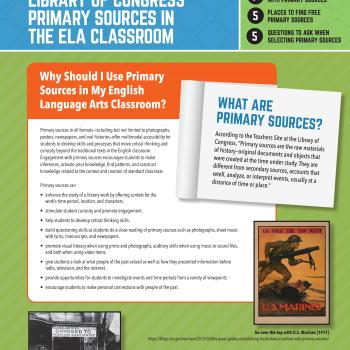
Engaging Students with Library of Congress Primary Sources in the ELA Classroom Quick-Reference Guide (QRG)
Quick-Reference Guide (QRG) focused on "Engaging Students with Library of Congress Primary Sources in the ELA Classroom."