Students take a postcolonial perspective on the portrayal of Caliban from Shakespeare's The Tempest by comparing it to a modern adaptation of the play.

Reading Shakespeare's The Tempest through a Postcolonial Lens

Examining History with Maya Angelou's Poetry
To understand the historical background that influenced Maya Angelou's poems, students research events to produce trading cards using the ReadWriteThink Trading Card Student Interactive. Through the sharing of these trading cards, students understand the historical background as they analyze Angelou's poetry.
Huge Mistakes that Led to Catastrophe: Learning about Human-made Disasters throughout History
After researching various human-made disasters such as the BP oil spill, the sinking of the Titanic, and the Great Chicago Fire, students share their research in oral presentations. Then students pair up to compare and contrast their disasters using the Venn Diagram Student Interactive or the Venn diagram Mobile App.

Picture This: Using Instagram to Report
After taking a field trip that students document using mobile app Instagram, students become new reporters as they use the interactive Printing Press to tell about their experiences.

Aim for the Heart: Using Haiku to Identify Theme
Using haiku, students focus on themes in literature and demonstrate their understanding of an author's message. Writing haiku to accompany an analytical paper hones analytical skills and fosters creative expression.

Learning about Clouds with Haikus
Using a mobile app or Interactive activity, students write haikus describing various types of clouds that they have studied.

Using Mobile Devices to Illustrate Literary Devices
Using mobile devices, students capture images to represent literary devices. Students then reflect on why their images depict the literary devices.

How Big Are Martin's Big Words? Thinking Big about the Future
Inspired by the book Martin's Big Words, students explore information on Dr. King to think about his "big" words, then they write about their own "big" words and dreams.

Get the Reel Scoop: Comparing Books to Movies
Students compare a book to its film adaptation, and then perform readers theater of a scene from the book that they feel was not well represented in the movie version.
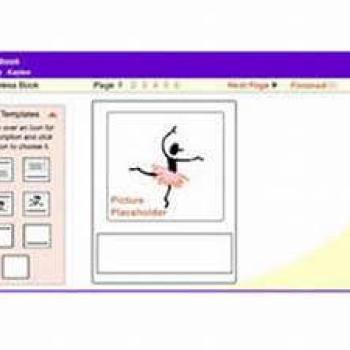
Stapleless Book
The Stapleless Book can be used for taking notes while reading, making picture books, collecting facts, or creating vocabulary booklets . . . the possibilities are endless!
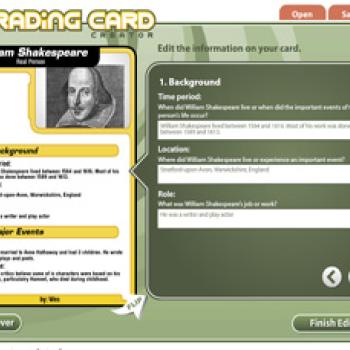
Trading Card Creator
This tool provides a fun and useful way to explore a variety of topics such as a character in a book, a person or place from history, or even a physical object. An excellent tool to for summarizing or as a prewriting exercise for original stories.
Power of Picture Books, The: Using Content Area Literature in Middle School
Featuring descriptions and activities for fifty exceptional titles, Mary Jo Fresch and Peggy Harkins offer a wealth of ideas for harnessing the power of picture books to improve reading and writing in the content areas.
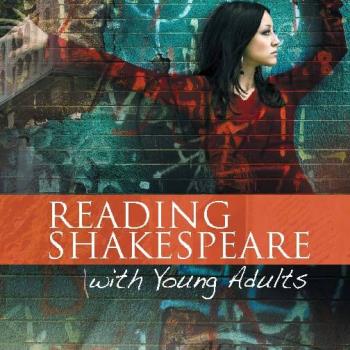
Reading Shakespeare with Young Adults
Dakin explores different methods for getting students engaged--and excited--about Shakespeare's plays as they learn to construct meaning from the texts' sixteenth-century language and connect it to their twenty-first-century lives.

Connection Web
Students use this printout to expand on connections they have made to a text and use those details to write essays or create projects about the text.

RAFT Writing Template
Students can utilize this printout to organize their writing as they learn to use the RAFT strategy. This printout enables students to clearly define their role, audience, format, and topic for writing.

Tips For Using Movie Maker
It's easy to make a movie today, thanks to software that may already be on your home computer. Sounds fun, and it's a lesson in how to communicate ideas.

Choral Reading
During choral reading, students read together orally. Repeated, supported reading helps students read with greater expression and read unfamiliar words with greater ease.
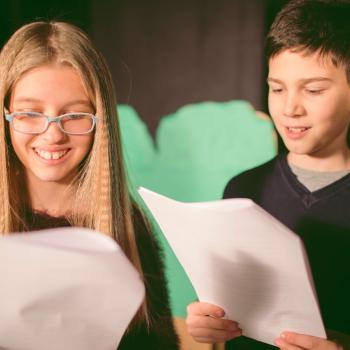
Readers Theatre
Readers Theatre integrates oral reading, literature, and the performing arts. This strategy can entice the most reluctant and disinterested reader to become engaged in reading.

Using the Think-Pair-Share Technique
In this strategy guide, you will learn how to organize students and classroom topics to encourage a high degree of classroom participation and assist students in developing a conceptual understanding of a topic through the use of the Think-Pair-Share technique.

Using the RAFT Writing Strategy
This strategy guide introduces the RAFT technique and offers practical ideas for using this technique to teach students to experiment with various perspectives in their writing.