Students practice writing detailed, sensory-rich descriptions by framing a small piece of nature and freewriting about it. From this minilesson, students can develop a variety of types of writing.

Creative Writing in the Natural World: A Framing

The ABCs of Poetry
Students examine a letter of the alphabet from all angles, creating image pools of original metaphors that they then turn into poems.

Finding Common Ground: Using Logical, Audience-Specific Arguments
Using a hypothetical situation, students generate arguments from opposing points of view, discover areas of commonality using Venn diagrams, and construct logical, audience-specific arguments to persuade their opponents.

Decoding the Dystopian Characteristics of Macintosh's "1984" Commercial
This lesson uses the "1984" Macintosh Commercial to introduce students to dystopian characteristics. Students analyze techniques used in the commercial and identify the comments that it makes about contemporary society.

Onomatopoeia: A Figurative Language Minilesson
Clang, clash, or tinkle? Students explore the use of onomatopoeia in Edgar Allan Poe's "The Bells" before choosing their own sound words in response to specific sounds.

Draft Letters: Improving Student Writing through Critical Thinking
Draft letters ask students to think critically about their writing on a specific assignment before submitting their work to a reader. This lesson explains and provides models for the strategy.
You're the Top! Pop Culture Then and Now
Students analyze the lyrics to Cole Porter's "You're the Top!" and then update them to include current "tops" in pop culture.
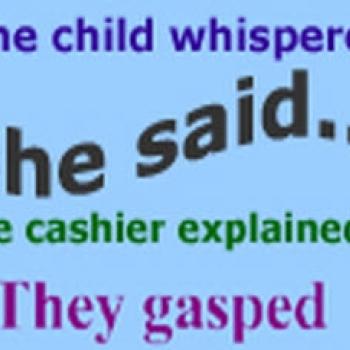
Choosing Clear and Varied Dialogue Tags: A Minilesson
In this minilesson, students explore the use of dialogue tags such as "he said" or "she answered" in picture books and novels, discussing their purpose, form, and style.

Choosing the Best Verb: An Active and Passive Voice Minilesson
Students explore how active and passive voices are appropriate to different audiences. They examine online resources, and then draw conclusions about verb use, which they apply to their own writing.

Is a Sentence a Poem?
Students use their own poetry to analyze syntax, imagery, and meaning in a one-sentence poem by a canonical author to decide what makes it a poem.

Prove It!: A Citation Scavenger Hunt
Students are challenged to find citations that support details about the characters, plot, or themes from a text.
Research Building Blocks: "Organize This!"
In this minilesson, students organize information they compile while doing research for a written report on a selected topic.

Research Building Blocks: Examining Electronic Sources
In this lesson, students evaluate and rate the relevance of electronic resources as they research information about their state.

Research Building Blocks: Notes, Quotes, and Fact Fragments
Students are guided through the process of taking notes while reading factual information, then turning those notes into new sentences and paragraphs written in their own words.

Research Building Blocks: Hints about Print
In this lesson from a research skills unit, students examine abstracts on selected books to determine their relevance and helpfulness.
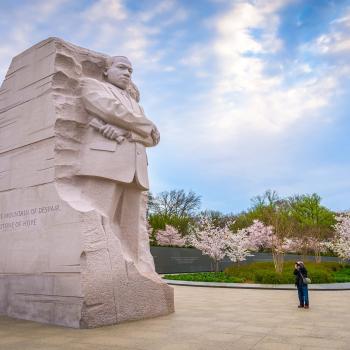
How Big Are Martin's Big Words? Thinking Big about the Future
Inspired by the book Martin's Big Words, students explore information on Dr. King to think about his "big" words, then they write about their own "big" words and dreams.
What Makes Poetry? Exploring Line Breaks
Students read various poems and explore why lines are broken where they are and how they affect rhythm, sound, meaning, and appearance in poetry.

And I Quote: A Punctuation Proofreading Minilesson
Students review the basic conventions for using quotations from literature or references from a research project, focusing on accurate punctuation and page layout, then apply the conventions to their texts.

Using the Internet to Facilitate Improved Reading Comprehension
Could some common online activities actually improve reading comprehension? Understanding RSS feeds requires inferential thinking, as students use the summary to draw conclusions about the full content.

Promoting Cultural Values Through Alphabet Books
C is for Culture in this lesson in which students research a culture different from their own and compile an alphabet book that showcases cultural symbols for each letter of the alphabet.