Using this printout, students make personal associations to a text by finding and describing text-to-text, text-to-self, and text-to-world connections.
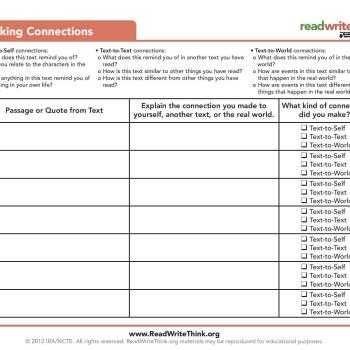
Making Connections

Narrative Pyramid
After students read a short story or chapter of a novel, they can use the Narrative Pyramid to reflect on key ideas and details.
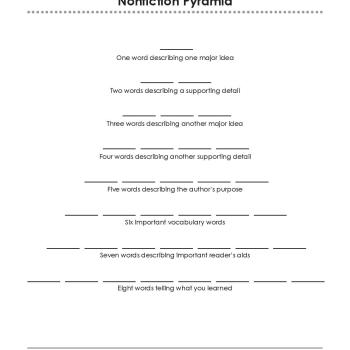
Nonfiction Pyramid
After students read an article or other work of nonfiction, they can use the Nonfiction Pyramid to reflect on key ideas and details in the text.

Connection Stems
Connection Stems give students the language (and a reminder) to support their understanding by tying new learning to what they know about themselves and their world.

K-W-L-S Chart
This printable extends the familiar K-W-L's means of organizing students' prior knowledge, formulating inquiry questions, and recording new learning by adding space for questions for further inquiry.

Venn Diagram, 3 Circles
Students use this graphic organizer to describe similarities and differences between three objects or ideas.

I-Chart
This printout assists students with generating meaningful questions about a topic and organizing their writing by using a structured guide while researching.

Concept Map
This concept map can be used in a variety of ways to show relationships between words and phrases. Students can add arrows as needed and group certain ideas together.

Connection Web
Students use this printout to expand on connections they have made to a text and use those details to write essays or create projects about the text.
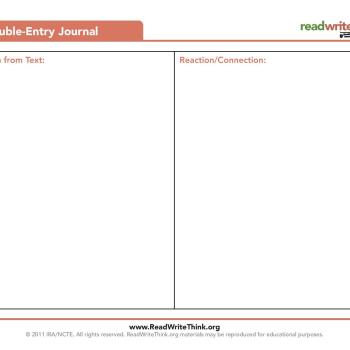
Double-Entry Journal
This printout helps students record ideas and situations from texts in one column, and their reactions in the second, thus making a connection between the text and themselves, another text, or the world.

Seed Discussion Organizer
Students can utilize this printout to organize their thoughts as a new concept or content is introduced through a Seed Discussion. This printout readies students to acquire new knowledge by organizing what they know and what they're prepared to learn.

Sequence of Events Chart
This graphic organizer helps students see the sequential or cause-effect relationships between multiple events in a text.

Persuasion Map
Use this graphic organizer to develop a persuasive stance for an essay, speech, poster, or any type of assignment that incorporates persuasion.

K-W-L Chart
This K-W-L Chart, which tracks what a student knows (K), wants to know (W), and has learned (L) about a topic, can be used before, during, and after research projects.

T-Chart
Use this T-Chart to examine two facets of an object, situation, or event and to make comparisons related to a variety of subjects and content areas.

Compare and Contrast Chart
This organizer can be used to help students explain similarities and differences between two things or ideas. After this organizer has been completed, it could easily be developed into a classroom discussion or writing topic on the information gathered.

Conflict Map
Ask students to remember a story with no problem or conflict. That would be difficult to do! With this printout, students learn to examine the critical plot element of conflict.
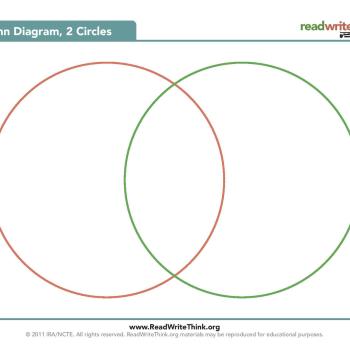
Venn Diagram, 2 Circles
Students use this graphic organizer to describe similarities and differences between two objects.

Essay Map
Use this graphic organizer to develop an outline for an essay that includes an introductory statement, main ideas, supporting details, and a conclusion.