As part of an I-Search writing process, this handout facilitates the formation of meaningful questions and subquestions for student inquiry.

I-Search Chart
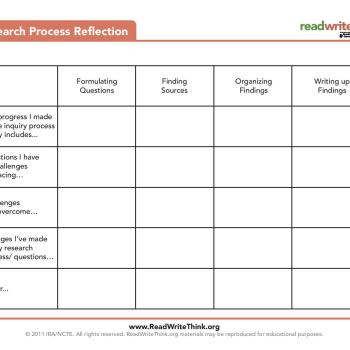
I-Search Process Reflection Chart
This chart asks students to consider their challenges and successes across the span of the research process, from question formulation to the final write-up.

Exit Slips
This printout provides prompts that help students reflect on and process new information and think critically, and offers teachers the opportunity to differentiate upcoming instruction based on these reflections.

Haiku Starter
This graphic organizer provides students the opportunity to brainstorm words about a given topic, count and record the syllables, and draft a haiku.

Connection Web
Students use this printout to expand on connections they have made to a text and use those details to write essays or create projects about the text.
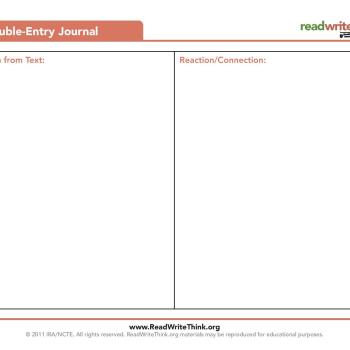
Double-Entry Journal
This printout helps students record ideas and situations from texts in one column, and their reactions in the second, thus making a connection between the text and themselves, another text, or the world.

RAFT Writing Template
Students can utilize this printout to organize their writing as they learn to use the RAFT strategy. This printout enables students to clearly define their role, audience, format, and topic for writing.

Persuasion Map
Use this graphic organizer to develop a persuasive stance for an essay, speech, poster, or any type of assignment that incorporates persuasion.

Essay Rubric
This rubric delineates specific expectations about an essay assignment to students and provides a means of assessing completed student essays.

Diamante Poem
This tool will allow your students to create a diamante poem by reflecting on their knowledge of a topic and by using nouns, verbs, and adjectives in a creative manner.

Essay Map
Use this graphic organizer to develop an outline for an essay that includes an introductory statement, main ideas, supporting details, and a conclusion.

Being a YA Lit Advocate
Tune in to hear about what it means to be a YA lit advocate and what YA advocacy work can look like. You'll learn strategies you can use to challenge misconceptions about YA lit. You'll also hear about a variety of fiction and nonfiction titles you can recommend to teen readers.

Finding the YA Community at NCTE Convention
Tune in to hear about specific things you can do to find the YA community at NCTE Annual Convention. You'll learn about the kinds of YA lit sessions that typically appear on the program, and you'll hear tips from YA advocates about how to make the most of the opportunity to meet authors, discover new books, and connect with others who love young adult literature as much as you do.

Appreciating Audiobooks
In this episode, you'll hear about what goes on behind the scenes in audiobook production. You'll also hear samples from an array of distinguished audio titles including YA classics as well as newer works of contemporary realistic fiction, dystopian fiction, historical fiction, and novels written in verse.

A Conversation with Candace Fleming
In the world of young adult literature, some of today's best and most powerful stories are being told by authors of nonfiction. Tune in to hear Candace Fleming discuss the origins of The Family Romanov, research as a process of questioning, and how authors of nonfiction are pushing the envelope in books for today's teens.

A Conversation with Walter Dean Myers
If there is anyone in the world of children's and young adult literature who could be described as a living legend, it's Walter Dean Myers. Tune in to hear how his own experiences as a reader have shaped his approach to storytelling, what he seeks to offer young people through his writing, and the thinking behind a select handful of his novels – books that incorporate concepts as varied as magical realism, the social contract, and oral histories with our nation's war veterans.

A Conversation with Rita Williams-Garcia
It's rare to find historical fiction that weaves rich period detail into the lives of memorable and endearing characters, but Rita Williams-Garcia's middle-grade novels One Crazy Summer and P.S. Be Eleven do just that. Tune in to hear Rita explain how she drew on personal and historical contexts to develop her characters and tell their story. You'll also hear about her great love for her work and her commitment to spending as long as it takes to get the story right.

Making Connections
In this strategy guide, you'll learn to model how students can make three different kinds of connections (text-to-text, text-to-self, text-to-world). Students then use this knowledge to find their own personal connections to a text.

Using the Think-Pair-Share Technique
In this strategy guide, you will learn how to organize students and classroom topics to encourage a high degree of classroom participation and assist students in developing a conceptual understanding of a topic through the use of the Think-Pair-Share technique.

Using the RAFT Writing Strategy
This strategy guide introduces the RAFT technique and offers practical ideas for using this technique to teach students to experiment with various perspectives in their writing.