Students explore letter poems and experiment with writing letters as poems, using the placement of line breaks to enhance rhythm, sound, meaning, and appearance.

Letter Poems Deliver: Experimenting with Line Breaks in Poetry Writing
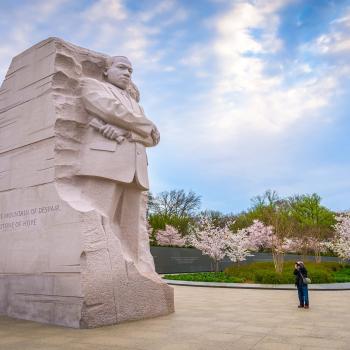
How Big Are Martin's Big Words? Thinking Big about the Future
Inspired by the book Martin's Big Words, students explore information on Dr. King to think about his "big" words, then they write about their own "big" words and dreams.
It Doesn't Have to End That Way: Using Prediction Strategies with Literature
After listening to the beginning of a story, students use details in the text, personal experience, and prior knowledge to predict the way the story will end.

Breaking Barriers, Building Bridges: Critical Discussion of Social Issues
Through a series of picture book read-alouds, students engage in critical discussion of complex issues of race, class, and gender.
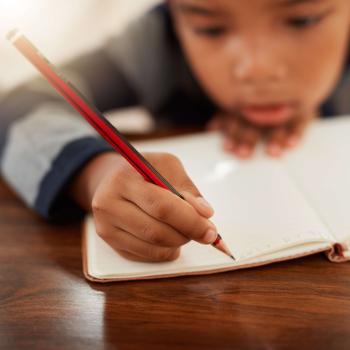
Family Message Journals Teach Many Purposes for Writing
This lesson encourages children to explore authentic reasons for writing by writing messages to their family in a family message journal.

Book Clubs: Reading for Fun
This lesson describes how small groups of students can plan meetings to discuss what they've read in a "just for fun" book club they've organizedand that they control.

Daily Book Boosts
Book Boostsone-minute raves at the end of independent reading timeare easy ways to suggest new titles to students, and they act as a way for students to have something to think about as they read.

Learning to Learn with Miss Alaineus: A Vocabulary Disaster
Modeled on the activities in Miss Alaineus: A Vocabulary Disaster, a picture book, students combine vocabulary exploration with word play by planning their own vocabulary parade.

Literature Circles with Primary Students Using Self-Selected Reading
Students respond to self-selected books in journals, and talk about their books daily in small groups. The teacher guides students by offering suggestions and writing with them in dialogue journals.

Have Journal...Will Travel: Promoting Family Involvement in Literacy
Students build positive memories of literacy activities when they take turns taking home a book bag stuffed with items to encourage literacy interactions with their families.
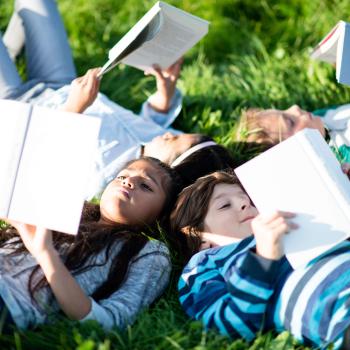
Literature Circles: Getting Started
Students practice different ways of collaborating to read a work of literature. They work in different roles as they compose and answer questions, discover new vocabulary, and examine literary elements.
Writing and Assessing an Autobiographical Incident
Students build upon their knowledge of biographies to write their own autobiographical incident. After going through a process of revision, they use a rubric to assess their work.

Guided Comprehension: Making Connections Using a Double-Entry Journal
Based on the Guided Comprehension Model by Maureen McLaughlin and Mary Beth Allen, this lesson helps students learn three types of connections (text-to-text, text-to-self, and text-to-world) using a double-entry journal.

Persuading Readers with Endorsement Letters
Students explore the genre of commercial endorsements, establishing characteristics and requirements for the genre. Each student then composes an endorsement of a product, service, company, or industry.

Color of Silence: Sensory Imagery in Pat Mora's Poem "Echoes"
Pat Mora's poem "Echoes" demonstrates that our senses are powerful tools for literary analysis and comprehension as students use their senses to discover new ways to read and write.

Analyzing and Comparing Medieval and Modern Ballads
Students explore the ballads genre by reading medieval ballads to deduce their characteristics, acting out the ballads, comparing medieval and modern ballads using Venn diagrams, and composing their own ballads.