Working in small groups, students read and discuss Elie Wiesel's memoir Night and then take turns assuming the "teacher" role, as the class works with four different comprehension strategies.

Using Student-Centered Comprehension Strategies with Elie Wiesel's Night

Focus on First Lines: Increasing Comprehension through Prediction Strategies
Students examine opening sentences of texts they will read during a unit or course and make predictions. They return to their predictions throughout the course as they read the texts.
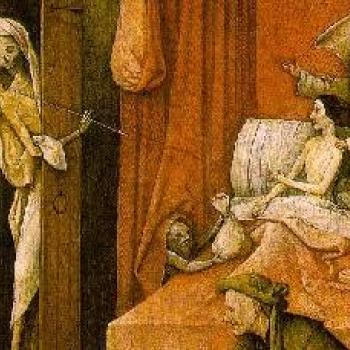
Analyzing Symbolism, Plot, and Theme in Death and the Miser
Students apply the analytical skills that they use when reading literature to an exploration of the underlying meaning and symbolism in Hieronymous Bosch's early Renaissance painting Death and the Miser.

A Significant Influence: Describing an Important Teacher in Your Life
In this project, students write tributes to teachers who have made a profound difference in their lives then publish their work in a class collection.
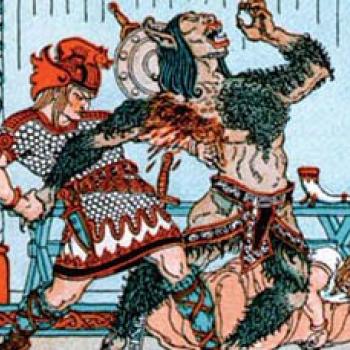
Reading Literature in Translation: Beowulf as a Case Study
Using several translations of the same passage of Beowulf, this lesson introduces students to the idea that translation is not an objective practice, but that it involves "imaginative reconstruction."

Exploring Satire with Shrek
The movie Shrek introduces the satirical techniques of exaggeration, incongruity, reversal, and parody. Students brainstorm fairy tale characteristics, identify satirical techniques, then create their own satirical versions of fairy tales.

Reader Response in Hypertext: Making Personal Connections to Literature
Students write a narrative of place, a character sketch, an extended metaphor poem and a persuasive essay then link all four texts to quotations they have selected from a novel.

Short Story Fair: Responding to Short Stories in Multiple Media and Genres
In this activity, students read short stories and create presentations in multiple media to share in a Short Story Fair. At the fair, students explore and respond to the displays.

Freedom of Speech and Automatic Language: Examining the Pledge of Allegiance
This lesson has students explore freedom of speech by examining the Pledge of Allegiance from a historical and personal perspective and in relationship to fictional situations in novels.

Exploring Literature through Letter-Writing Groups
Students discuss literature through a series of letter exchanges, as a one-time assignment or throughout the year with the students discussing, and making connections among, a number of literary works.

Happily Ever After? Exploring Character, Conflict, and Plot in Dramatic Tragedy
By exploring the decisions points in a tragedy, students consider how the plot of the story can change if the key characters make a different choice at the turning point.

Paying Attention to Technology: Exploring a Fictional Technology
Students complete a short survey to establish their beliefs about technology. They compare their opinions to the ideas in a novel that depicts technology (such as 1984 or Fahrenheit 451).
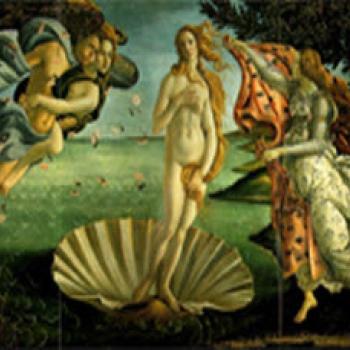
Renaissance Humanism in Hamlet and The Birth of Venus
After reading Shakespeare's Hamlet, students identify, analyze, and explain how elements in Botticelli's painting Birth of Venus and examples from the play illustrate the philosophy of Renaissance Humanism.

Weaving the Multigenre Web
Students analyze the elements of a novel in many different genres and then hyperlink these pieces together on student-constructed Websites.
Style: Defining and Exploring an Author's Stylistic Choices
Students find examples of specific stylistic devices in sample literary passages then search for additional examples and explore the reasons for the stylistic choices that the author has made.

Graffiti Wall: Discussing and Responding to Literature Using Graphics
Tap students' desires to doodle and draw by having them create a Graffiti Wall, using graphics to discuss a piece of literature that has been read by the whole class.

Novel News: Broadcast Coverage of Character, Conflict, Resolution, and Setting
This twist on readers theater has students prepare original news programs based on incidents in a recent reading, as they explore standard literary elements of character, conflict, resolution, and setting.

Name That Chapter! Discussing Summary and Interpretation Using Chapter Titles
Students name unnamed chapters in a novel they are reading. They discuss possible chapter names, considering accuracy, word choice, and connotation, before settling on a choice.

An Introduction to Julius Caesar Using Multiple-Perspective Universal Theme Analysis
This resource is an introduction to William Shakespeare's tragic play, The Tragedy of Julius Caesar, through the study of universal themes using multiple-perspective investigations of betrayal scenarios.

Breaking the Rules with Sentence Fragments
Though teachers usually caution students against using sentence fragments, Edgar Schuster's work demonstrates that professional writers often use fragments effectively. This lesson helps students understand that there are reasons that they can and should use sentence fragments to become effective writers.