
Often considered to be the first true copyright law, the Statute of Anne drastically changed how copyright worked in Great Britain by naming the author, rather than the publisher, as the holder of the copyright. Later, this law had great influence on emerging U.S. copyright laws. In fact, the first U.S. copyright law began with "An Act for the Encouragement of Learning" —words taken directly from the Statute of Anne.
Create a students' copyright guide as a handy reference for classroom work or the library.
- First, form small groups to conduct web research on copyright issues. Assign groups topics, such as the types of copyright protected works, fair use, court cases, public domain works, and so on. Students can use the interactive Notetaker to help them organize their research findings.
- After students have finished their research, have each group compile their information into a page for the class booklet, by visiting the Printing Press tool and selecting the "flyer" option.
- Collect each group's work and create a booklet. Be sure to create a table of contents and index for the guide, as well as a cover page. Keep a copy of the guide in the library and near photocopying machines.
- You might also want to reproduce the guide and distribute a copy to each student.
This site offers teachers information on copyright issues, including a list of links to online copyright references.
This website provides resources for children, as well as parents and teachers. Included are copyright basics, a quiz, and more.
This series on copyright law and the fair use exceptions is aimed at teachers and covers things such as applying the law to new technologies and district liability.
This student interactive, from CyberBee, answers many questions students may have about intellectual property rights and fair use.

Amy Tan is a Chinese-American author best known for her examinations of relationships between mothers and daughters such as her 1989 novel The Joy Luck Club.
Project for students an excerpt of an interview with Amy Tan (Q8: Chinese Characters, 1:09:45 to 1:11:00). Discuss their impressions of her stance toward writing from her personal experience as an extension of her identity. Then invite students to tell a story of their own, either a fictionalized account of a memory or family experience or a more straightforward true story that is important to them and who they are.
Share the Story Map or the Story Cube interactives to help students generate and organize their ideas. Then give students the opportunity to share their stories by holding a classroom reading or creating an online or print collection.
Tan's eclectic website offers biographical information, photos, and multimedia.
In this TED Talk, Tan explores her creative process and the relationships between chance, ambiguity, and her fiction.
In this piece from The Atlantic, Tan reflects on an excerpt from Whitman's "Song of Myself" and relates it to her processes as a writer.
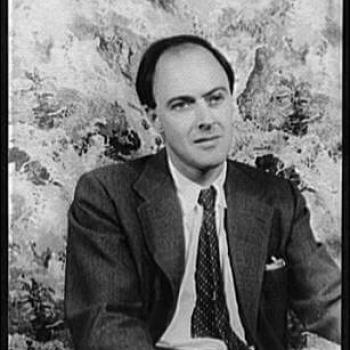
Roald Dahl was born in Wales on September 13th, 1916. His first book for children, The Gremlins, was written in 1943. Following this, Dahl went on to write several of the most popular children's stories of the 20th century, including Charlie and the Chocolate Factory, Matilda, and James and the Giant Peach. Several of Dahl's stories, including these, have been made into motion pictures. He died in 1990.
Have students adapt a Roald Dahl story to picture book format. Read a Roald Dahl story that has been adapted to film (Charlie and the Chocolate Factory, James and the Giant Peach, Matilda) Then show students the film. Have students use the Interactive Venn Diagram or Mobile App to compare and contrast the two versions, focusing on the images in the movie:
- How were the two experiences different? Similar?
- How did the images in the movie affect the story? Your enjoyment of the story?
- What are the benefits of reading a story? Of watching a film?
- How is the story in the movie different? Why do you think this is so?
Then have students create original picture book versions of the story. Afterwards, have students share their books and then add them to the classroom library.
This site offers news, contests, quizzes, activity ideas, and more to help readers around the world celebrate Roald Dahl Day on his birthday.
Roald Dahl's official site features a biography, photo gallery, author interview, online activities, and more.
The BBC Wales provides this audio interview with Roald Dahl’s relatives and related biographical information.
This site offers activites, suggestions, and ideas for celebrating Roald Dahl Month all September long!

Born in 1927, Coretta Scott King was well-known as a courageous wife and widow, and for her personal commitment to civil rights across the globe, until her own death in early 2006. In 1970, Mrs. King lent her name to the Coretta Scott King Book Awards, established to honor African American authors and illustrators for outstandingly inspirational and educational contributions. The awards are presented annually by the American Library Association.
Use a list of current and past Coretta Scott King Book Award winners as a booklist for a book report assignment. The rich variety of literature offers something for all tastes, including nonfiction, fiction, short stories, biographies, and more. First have each student select a book from the list and then have students complete one of these book report alternatives from ReadWriteThink:
- Book Report Alternative: Writing Resumes for Characters in Historical Fiction
- Book Report Alternative: Character and Author Business Cards
- Book Report Alternative: Comic Strips and Cartoon Squares
- Book Report Alternative: The Elements of Fiction
- Book Report Alternative: Summary, Symbol, and Analysis in Bookmarks
- Book Report Alternative: Examining Story Elements Using Story Map Comic Strips
- Book Report Alternative: Hooking a Reader with a Book Cover
- Book Report Alternative: Creating a New Book Cover
This American Library Association page provides a brief history of the Coretta Scott King Award. There is information about the seal's design, a timeline of milestones and links to the list of current and past winners.
This resource from the Academy of Achievement includes a biography of Coretta Scott King, celebrating her civil right achievements. A transcript and video clips from an interview with King are also included.
The Yale-New Haven Teachers Institute offers this curriculum unit on teaching with African-American picture books. Suggested reading lists for both students and teachers are included.

Edward Irving Wortis was born on December 23, 1937, in New York City. As a child, his twin sister Emily called him "Avi," which is now the only name he uses. Despite his struggle with dysgraphia, Avi decided to focus on writing as a senior in high school. His first book was published in 1970 and he has published over 30 books since then. Avi was honored with the Newbery Medal for Crispin: Cross of Lead and a Newbery Honor for Nothing But the Truth.
In Nothing But the Truth, Avi writes in a documentary style, using journal entries, dialogue, and other writing genres. After reading this novel, have your students explore a current event topic and write their own short work of fiction in a similar multigenre format.
- Have students research and select a current event topic of interest. Provide print resources such as magazines and newspapers, as well as access to news on the Web.
- As a group, brainstorm a list of possible genres to include in a documentary-style story. The list could include those used in Nothing But the Truth, such as maps, poems, letters, or interviews.
- Have students make brief presentations to the class on the topics they have chosen, including the resources they have selected for inclusion in their writing. Encourage constructive criticism and sharing of ideas for alternate resources students might include.
- Have students use the feedback to plan their stories before writing. You may wish to have students use the Literary Elements Mapping tool to help with planning.
- Finally, have students write their stories. Publish the stories on a bulletin board or in a class book.
Avi's official website includes lists of his books, organized by genre or topic, as well as biographical information and information for teachers.
In this interview with Reading Rockets, Avi talks about the challenges of writing, his years as a librarian, and his symptoms of dyslexia.
This guide, from Holt, Rinehart and Winston, Inc., provides a list of characters, chapter summaries, and related activities for Avi's novel.

Born in England, Macaulay came to the U.S. as a child. He received his B.A. in architecture in 1969 and has since worked as an illustrator, graphic designer, and author. Macaulay is well known for his books on architectural structures, which feature a unique genre blend of fact and fiction. He has earned a number of awards for his work, including the Caldecott Medal (for Black and White) and Honor Awards (for Castle and Cathedral).
Invite your students to explore Macaulay's use of multiple genres by composing original multigenre texts using the interactive Multigenre Mapper. This tool invites students to create original works that include one drawing and three texts.
- First, select a topic for students' multigenre texts. You might choose a subject you are currently studying in science or social studies or let students choose their own topics.
- Next, ask students to brainstorm a set of subtopics and possible writing genres (for example, poetry, recipes, fables, journal entries, or news articles) that could be used to share the subtopics with readers in an engaging way.
- Have students use the Multigenre Mapper Planning Sheet to write rough drafts of their texts.
- Finally, have students visit the interactive Multigenre Mapper to compose their texts online.
Have students print and share their final texts, explaining how they blended different genres to create their final products. Create a display or index of the texts so that other students in the school can enjoy them. Include some of Macaulay's texts to tie the project together.
David Macaulay's site at Houghton Mifflin offers information about Macaulay and his books. Highlights include a video of Macaulay at work, animated demonstrations and slide shows of parts of his books, and the text of some of his speeches and interviews.
This workshop from the "Write in the Middle" program focuses on multigenre writing and includes a related reading from the NCTE journal Language Arts.
PBS offers this companion site to their series Building Big, hosted by David Macaulay. The site offers an Educator's Guide to the series, as well as several interactive features.
Children's Book Week encourages children to enjoy new authors and books, and is celebrated in schools, libraries, homes, and bookstores during a selected week in May and November. During this event, celebrate children's literature with storytelling, parties, author and illustrator appearances, and other literacy events in your school and community. As part of the celebration, children are invited to help select the top children's book of the year by voting online or at their school or library.
The winners of the Children's Choice book awards will be announced during National Book Week. Before the winners are announced, children across the nation will be able to vote for their favorites. Invite your students to show why their favorite finalist should win by designing a promotional book cover.
- First, have students read Children's Choice finalist books in their grade range. Younger students can read all five finalists, while older students may read fewer.
- Then, ask each student to select his or her favorite finalist and brainstorm reasons why it is so good. Encourage students to consider specific elements, such as characters or plot.
- Next, have students look at their brainstormed lists and select the ideas that could be depicted on the book cover. Challenge each student to design a book cover that will convince others that his or her favorite should win.
- Finally, have students use the Book Cover Creator to create their book covers. They can then display their book covers with the book in a classroom or school display or on a bulletin board.
Access information about this annual event on this site from the Children's Book Council. Included are dates for this event for the next five years, book week materials and information, and more.
Help children find the perfect book with these children's, teachers', and young adults' choices booklists from the International Literacy Association.
This resource from Scholastic provides a collection of suggestions for holding a successful Book Week event in your school.

National Family Literacy Day®, celebrated across the U.S., focuses on special activities and events that showcase the importance of family literacy programs. First held in 1994, the annual event is officially celebrated on November 1st, but many events are held throughout the month of November. Schools, libraries, and other literacy organizations participate through read-a-thons, celebrity appearances, book drives, and more
Kick off National Family Literacy Day by inviting parents, grandparents, and other family members to your classroom for a family-school reading day.
- Invite students' family members to read a favorite story from their childhood, or their child's favorite bedtime story. (Grandparents can share both their child's and their grandchild's favorites!)
- Provide a collection of books for families to share during a group reading session. Invite families to get comfortable by bringing a cushion, beanbag chair, or pillow.
- Introduce families to some of the games & tools provided by ReadWriteThink. Encourage them to use these engaging tools at home to enhance their reading and writing experiences.
- Provide each family with a certificate of participation or a bookmark at the end of the event. Ask a local bookstore for a donation, or print certificates and bookmarks from your computer.
- At the close of your event, be sure to remind parents about other National Family Literacy Day events in your community.
Remember that family literacy is something that should be encouraged all year round. Invite students and their families to brainstorm ways they can keep their family engaged in reading on a regular basis!
NCFL provides support and strategies to a network of entities involved in advancing education and families learning together, including educators, schools, community based organizations, and libraries. Our efforts support learners of all ages in these environments in concert with our advocates and partners.
Reading Rockets offers resources for family literacy bags that students can take home to share with their families.
The International Literacy Association offers a series of brochures with literacy tips intended for parents. Some of the topics covered include reading with young children, watching television together, surfing the Web, the importance of nutrition, and more. Brochures are available for download in both English and Spanish.
Brought to life by the National Center for Families Learning (NCFL), our Wonders of the Day® will help you find learning moments in everyday life—ones that fit in with dinner preparations, carpool responsibilities, a stolen moment between breakfast and the bus, or within school curriculum and education programs.

Faith Ringgold began her career as a painter, and is best known for her painted story quilts, which combine painting, quilted fabric, and storytelling. Her first book Tar Beach earned a Caldecott Honor Award, as well as the Coretta Scott King Award for Illustration. Ringgold has written and illustrated 11 children's books, addressing issues of race, African American history, and civil rights.
Use Ringgold's books as a springboard for a discussion of race, gender, and civil rights-both current and historical. Then invite your students to write and illustrate original picture books based on these issues.
- First, have students brainstorm, select, and research a specific event or topic, such as Martin Luther King Jr.'s historic speech or the Underground Railroad.
- Then have students plan and write an illustrated story using the interactive Flip Book. The Flip Book allows students to create up to 10 pages and provides text, drawing, and background editing tools. See the Flip Book page for more information about this tool.
When their books are complete, students can be invited to take turns reading them to the class.
Faith Ringgold's homepage provides an author biography, a questionnaire about race, an author interview, and other related resources.
This resource from Scholastic provides a biography of Ringgold, as well as a link to a booklist.
This resource focuses on Ringgold's work as it relates to racism and gender inequality.
Random House provides this teacher's guide for Tar Beach, which includes book and author information as well as teaching ideas.
PBS offers information about Ringgold's painted story quilts.
In 1990, NCTE established an annual award for promoting and recognizing excellence in the writing of nonfiction for children in grades K-8. The name Orbis Pictus commemorates the work of Johannes Amos Comenius, whose Orbis Pictus-The World in Pictures (1657) is considered to be the first children's picture book. One title is selected for the award each November at the Annual NCTE Convention, and as many as five Honor Books are also recognized.
Have your students conduct research and write original works of nonfiction on topics of their choice. Students may wish to work collaboratively on this project as coauthors or author-illustrator teams.
- First, have students brainstorm possible topics individually or in small groups.
- After each student or team has selected a topic, have them conduct research using appropriate Orbis Pictus Award-winners, Internet resources, and other reference sources.
- Have students plan and write informational picture books, biographies, or other works of nonfiction. You may wish to have students create a Flip Book to help them organize their information.
The National Council of Teachers of English provides information on the annual Orbis Pictus Award, including its history, selection criteria, and nomination procedures.
This sample chapter from the NCTE text The Best in Children's Nonfiction explores the elements that come into play as the committee chooses the winner.
This page, from the State Library of South Australia, offers information about Johannes Amos Comenius and his illustrated Latin primer for which the Orbis Pictus award is named. Additional links and an image from the book are also included.